Free hiring tool
Roofing Sales Commission Plan Builder
Build a margin-aware roofing sales commission plan from your real numbers — average job size, gross margin, sales model, and payout structure. Enter them below and the builder drafts a plan with the compensation basis, payout trigger, supplement and cancellation rules, and a worked dollar example.
A roofing commission plan is harder than most sales comp because the numbers keep moving after the sale. A small repair and a full replacement can carry very different values. A supplement can change the plan-defined amount months later. A cancellation or a material overrun can erase margin you already paid a rep on. The plans that hold up decide those cases in writing, up front — not case-by-case when the first messy check lands. Below the builder you'll find the four structures with formulas and worked examples, a comparison table, and a pre-launch checklist.
Built by Tim Nussbeck — founder of GhostRep, 20+ years in home improvement sales. This tool is a planning aid, not payroll, tax, or legal advice.
Every plan the builder drafts covers
- Compensation basis. Whether commission comes off contract revenue or gross profit.
- Payout milestone. A proposed business milestone for payroll and legal review — signed, installed, or paid.
- Edge-case rules. Supplements, change orders, cancellations, and charge-backs, in writing.
- Margin check. A worked example showing modeled gross commission from submitted inputs.
Enter your details
Free to use. The output is a planning draft built from your inputs — run it past payroll and a qualified advisor, and confirm state wage rules, before you put it in front of a rep.
The four roofing commission structures
These four structures show the main calculation choices a roofing company may combine. The formulas use clearly hypothetical numbers to show the mechanics — they are not recommended rates. What's right for you depends on your margin, lead source, how much the rep controls, employment status, and local market.
Percentage of contract revenue
Commission = contract price × rate
Worked example (hypothetical): On a hypothetical $15,000 job at a 10% rate, modeled gross commission is $1,500 — before considering whether the plan’s proposed milestone was reached.
When it fits: Simplest to calculate and explain. The rep controls volume, not costs, so it fits company-lead retail where the office manages margin. The risk: on a thin-margin job, a revenue rate can pay out more than the job actually made.
Percentage of gross profit
Commission = (contract price − job costs) × rate
Worked example (hypothetical): On that same hypothetical $15,000 job with $9,750 in defined costs, gross profit is $5,250. At a 30% profit rate, modeled gross commission is $1,575; a different final cost changes the model.
When it fits: Ties pay to what the company keeps, which can align the payout with job margin. It may fit when the rep influences pricing, upgrades, or job costs. The trade-off: reps must trust your cost numbers, so your job-costing has to be clean.
Base plus commission
Pay = base + (basis × lower rate)
Worked example (hypothetical): A hypothetical $1,500/month base plus 6% of a defined commission basis. If $60,000 reaches the plan’s stated payout milestone that month, the modeled amount is $1,500 + $3,600 = $5,100.
When it fits: Keeps a nonrecoverable base separate from variable commission. Model both amounts against actual margin, and do not enter a recoverable draw as base pay.
Tiered commission
Rate steps up as the plan’s defined monthly basis crosses set thresholds
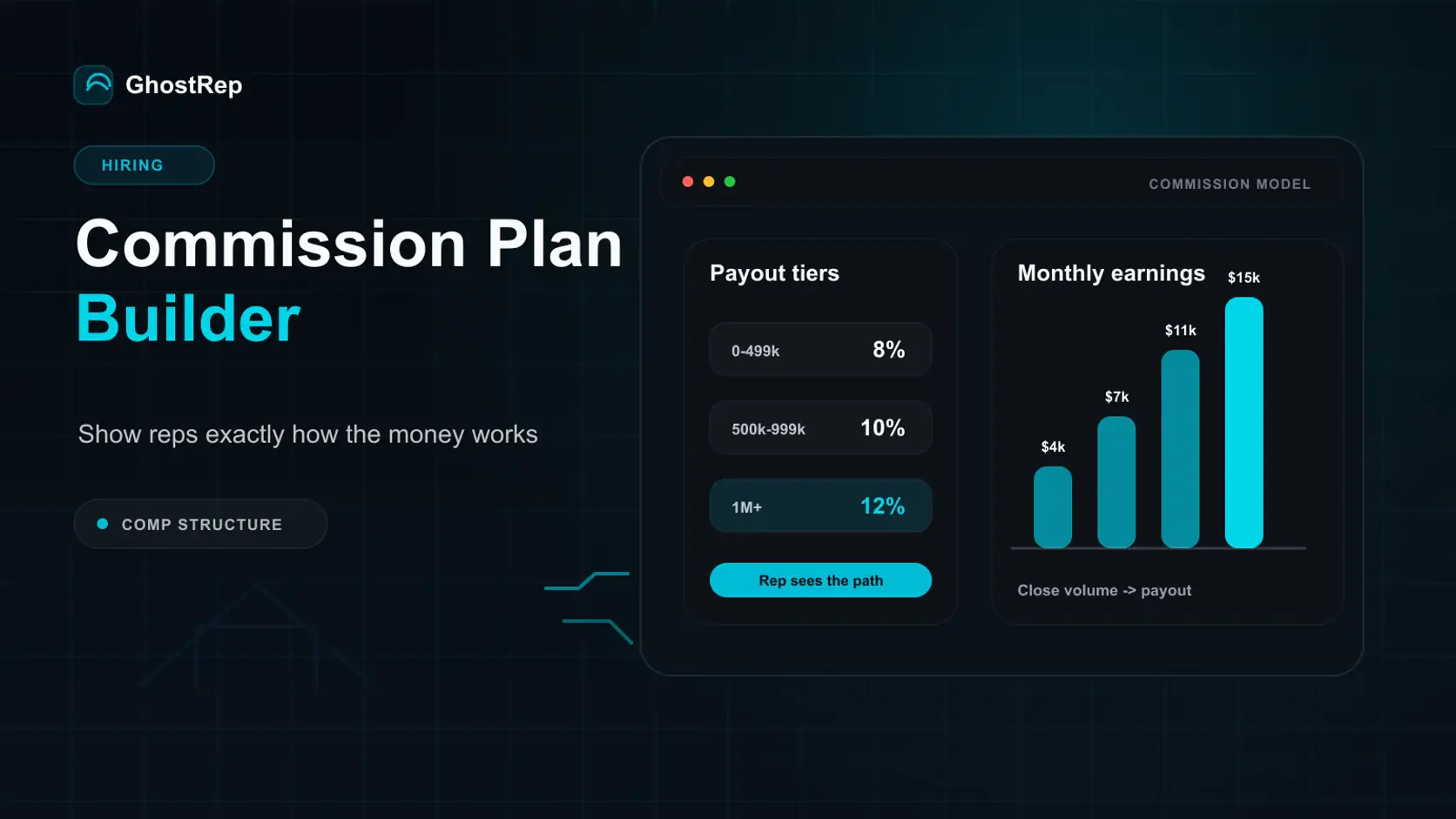
Worked example (hypothetical): A hypothetical ladder: 8% on the first $50,000, 10% on the next $50,000, and 12% above $100,000. If $120,000 of the defined basis reaches the stated milestone, that is $4,000 + $5,000 + $2,400 = $11,400, assuming marginal bands rather than a retroactive top rate.
When it fits: Changes the modeled rate after a stated threshold. Define the basis, reset period, and whether the upper rate is marginal or retroactive before comparing the result with gross margin.
Compare the four at a glance
Same job, four ways to pay it. This is the trade-off each structure is really making — pick for what you need to protect.
| Structure | Paid on | Protects | Watch out for |
|---|---|---|---|
| Contract revenue % | Top-line price | Volume | Can overpay on thin-margin jobs |
| Gross profit % | Price minus costs | Margin | Needs clean, trusted job-costing |
| Base + commission | Fixed base + lower rate | Recruiting / stability | Carries fixed payroll cost |
| Tiered | Rate rises with a defined basis | Makes rate progression visible | Define marginal vs. retroactive math |
Weighing two specific plans against each other? The commission plan comparison tool runs them side by side.
The rules that decide whether the plan holds up
The structure is the easy part. The harder part is defining how the written plan handles the moving parts before payroll has to apply it.
Lead source. A rep working company-provided leads and a rep self-generating their own aren't directly comparable — creating the pipeline adds work and may justify a different rate. Some roofing teams document separate company-lead and self-generated terms.
Supplements and change orders. Storm work especially: approved supplements can add thousands after the original sale. Decide the calculation basis and whether the plan recognizes the amount at approval, completion, or collection. For the estimating side, see upfront estimating for insurance jobs.
Cancellations and charge-backs. Name the window (a cancellation before material delivery is different from one after) and document the adjustment scenarios. Do not assume a deduction from future pay or separate repayment is permitted. Wage rules vary by state, so have payroll and counsel define the written terms before use.
Payout milestone, draws, and ramp. Pick a verifiable business milestone, then have payroll and counsel confirm when commission is legally earned and may be paid. If you use a draw during ramp, state the amount and duration; a qualified advisor should determine whether and how recovery is permitted. A draw is a comp mechanic, not a substitute for a real onboarding plan.
Pre-launch checklist
Before a new plan goes in front of a single rep, walk this list. Skipping it is how a plan that looked fine on a whiteboard turns into a margin leak or a trust problem three checks in.
- Commission comes off gross profit, or you’ve confirmed the revenue rate still clears margin on your thinnest jobs.
- The written plan identifies a proposed payout milestone — signed, installed, or paid — for payroll and legal review.
- Supplements and change orders state the calculation basis and whether the plan uses approval, completion, or collection.
- Cancellation and adjustment rules are written and reviewed against applicable wage laws before use.
- Draw terms (if any) state the amount and ramp length; a qualified advisor determines whether and how recovery is permitted.
- You modeled low, middle, and high production scenarios from company records before announcing it.
- A reviewer can reproduce modeled gross pay from the written inputs and formula.
- A payroll and legal review signed off before launch.
A compensation change and a performance change can occur at the same time without proving one caused the other. Review plan calculations, lead mix, job margin, payout timing, and sales behavior as separate evidence. To compare the economics of two written structures, use the commission plan comparison tool. For the pay section of a role posting, the job description generator turns your plan's real numbers into an honest pay section. Have qualified HR or legal counsel document the accepted employment terms in the company's approved agreement.
Frequently asked questions
What is a good roofing sales commission plan?
One a rep can calculate easily, aligned with the company’s margin model, and explicit about how commission is calculated and when it may be paid or adjusted. The structure that fits depends on average job size, gross margin, sales model, and whether the rep controls costs. Choose the basis that matches those responsibilities, spell out supplements and cancellations before launch, and have payroll and counsel review the written plan before use.
What percentage should I pay a roofing sales rep?
There is no single industry-standard percentage, and any source that quotes one is oversimplifying. The right rate depends on your gross margin, whether you provide the lead or the rep self-generates, how much of pricing and costs the rep controls, their employment status, and your local market. A company-lead rep and a self-generating rep on the same team can be paid very differently and both be fair. For what reps actually earn across roles and markets, see our roofing sales pay guide, and use the numbers here as planning inputs, not benchmarks.
Should commission come off revenue or gross profit?
Gross-profit plans can align pay with margin when the rep influences pricing, upgrades, or job costs. Revenue plans are simpler to calculate and may fit when the rep controls volume while the office owns pricing and production costs. Neither basis is automatically better: model both against real jobs, define the cost inputs clearly, and confirm the written terms with payroll and counsel.
How do I handle supplements, change orders, and charge-backs?
Decide the calculation method before the first check, not after the first dispute. State whether supplements and change orders enter the calculation when approved, completed, or collected. For cancellations and adjustments, document the scenarios but do not assume a future-pay deduction or separate repayment is permitted; have payroll and counsel define what the written plan may require under applicable wage laws.
When should a roofing rep’s commission be paid?
Choose a clear business milestone to propose in the written plan, such as contract signing, installation, or final collection, then have payroll and counsel confirm when commission is legally earned and when it may be paid in each state. The operational trade-off is cash flow versus speed for the rep, but company preference alone does not determine wage-law requirements.
Does employment status change the commission plan?
It can affect what structures are practical and what rules are permissible, and it’s a payroll and legal question, not a sales one. Whether a rep is an employee or an independent contractor turns on how the working relationship actually functions — the IRS uses a multi-factor test, not the label in a contract. This tool doesn’t make that determination. Sort classification first with our W2 vs 1099 guide and your own advisor, then build the plan.