In this article
Useful roofing sales call notes let the next person distinguish what the customer said, what the company verified and what still needs an answer. “Good meeting—follow up” loses those distinctions. A longer note fails too when it turns a reported problem into a diagnosis or a question into a promise.
The complete fictional example below turns one conversation into a usable record. Use the blank call-notes tool for a reusable structure; the notes-versus-scorecard guide explains when the manager also needs a separate behavior review.
Take Roofing Sales Call Notes in Seven Steps
1. Capture a few exact anchors
During the conversation, preserve only details that may be hard to reconstruct: a concern in the customer's words, a referenced document, an open question, or a dated commitment. Do not try to transcribe the appointment. Listening still comes first.
As soon as the conversation is over and the company's process allows, turn those anchors into a concise note. Do not improve the story. “Customer said the leak started after Tuesday's storm” is more trustworthy than “Tuesday's storm caused the leak.” The first preserves attribution; the second quietly invents causation.
2. Label facts, statements, and unknowns
Every important line should be understandable as one of three things:
- Verified company fact: information confirmed in an approved company source.
- Attributed statement: information a customer, rep, carrier representative, property manager, manufacturer, or other party stated.
- Unknown: information that has not been verified or conflicts with another source.
A customer statement can be important without being treated as verified. An unknown can remain open without being filled with the rep's best guess. That discipline protects the usefulness of every later handoff.
3. Reference the approved source
When the note mentions a proposal, photo set, inspection record, warranty reference, prior message, or company policy, point to the approved record rather than rewriting it from memory. The note can say that the proposal was reviewed and identify the internal source. It should not silently copy a number or scope detail that may change.
ServiceTitan's official roofing sales-visit workflow keeps images and notes available through Job History while the associate works with the job and estimate. Whatever software the company uses, the note should point to the source of record instead of becoming a second version.
4. Record commitments as they were made
A commitment needs an actor and an action. Add a date only when one was actually agreed or selected under company rules. “Send the approved ventilation-option comparison” is a company commitment only if someone from the company agreed to send it. “Customer will sign Friday” is not a commitment if the customer merely said they hoped to decide by the end of the week.
Keep company commitments and customer commitments separate. If the owner or date was not established, write that it still needs human selection. Do not manufacture certainty to make the note look complete.
5. Name one next action and one owner
Identify the immediate next action, responsible role, and any approved review date. A specialist may review a technical question, a rep may provide an approved document, or a manager may resolve a conflict. A customer's promise to call does not remove the company's need to select its own action.
This is not permission to redesign the opportunity. The sales pipeline template owns stages and exit criteria. A call note records what happened and flags the human-selected next action; it does not move the deal automatically or predict whether it will close.
6. Save the note in the approved system
Put the note where the company expects authorized teammates to find it. A private notebook, personal phone, stray text thread, or unapproved AI tool creates another version of the record and may expose information to the wrong place. Follow the company's access, retention, disclosure, and data-handling rules.
Microsoft's official Dynamics 365 documentation distinguishes a processed call view from editable notes containing commitments and next steps. This article teaches the human documentation method; it does not replace an authorized system.
7. Review anything that carries risk
Reread the record as a teammate who missed the appointment. Can that person tell what was verified, who stated each unverified item, what remains unknown, and who owns the next action? Route restricted technical, safety, pricing, financing, insurance, contract, or schedule issues to the authorized role.
Human review is not a cosmetic approval. The reviewer should correct the source, attribution, owner, or action while preserving a change history under the company's process. Never rewrite the note later to make the conversation look cleaner than it was.
Fact Versus Attributed Statement Versus Unknown
| Record type | What it means | Roofing example | How to write it | What not to do |
|---|---|---|---|---|
| Verified company fact | An authorized company source currently supports the statement. | The approved proposal record lists two company-defined material options. | State the narrow fact and reference the proposal record or approved source. | Copy pricing or scope from memory, or treat an old version as current. |
| Attributed statement | A named role or party said something that may matter, but the company has not independently verified it. | The customer stated that another contractor included decking in a verbal price. | Preserve who said it and the important words without endorsing the claim. | Write “competitor includes decking” as if the competing scope was reviewed. |
| Unknown | The information is missing, unresolved, or conflicts with another source. | Whether the two proposals use the same ventilation assumptions has not been verified. | Name the unknown, the source needed, and the authorized owner for verification. | Guess, choose the most convenient version, or label the unknown as an objection. |
This distinction also keeps the sales note separate from technical documentation. Use the roofing inspection summary generator for a company-approved blank structure around qualified property findings. A sales note may reference that record; it should not convert a homeowner statement or rep observation into a technical conclusion.
A Complete Fictional Conversation and Corrected Note
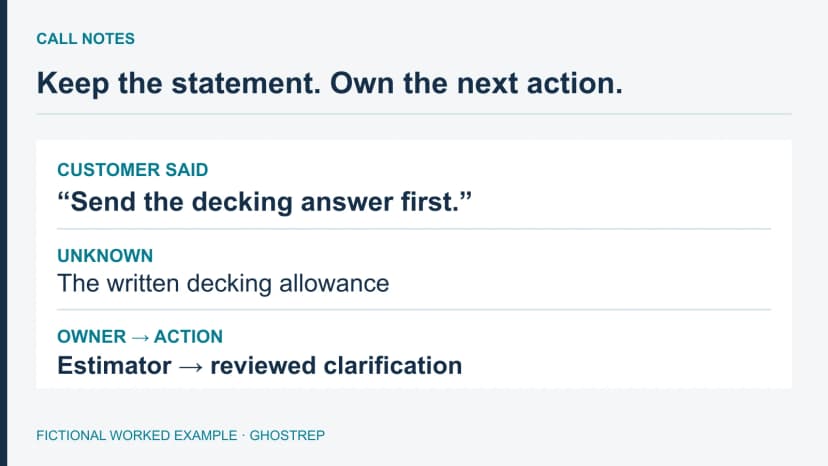
This proposal-review example uses invented records, no real customer information. Source S-22 revision 2 lists the proposed replacement but does not specify a decking quantity or additional-work price. That omission is the unresolved question, not proof that decking is included or excluded.
Homeowner: “A ceiling stain showed up after the last rain. Does this price include replacing bad decking?”
Rep: “Revision 2 does not give me a decking allowance I can explain. I will ask the estimator to clarify it in writing.”
Homeowner: “Please send that answer before I decide. Do not put me on the installation schedule.”
Rep: “I will send the reviewed clarification after the estimator confirms it. I am not scheduling installation.”
Raw note that loses the facts
Roof leaking. Decking included? Customer ready; schedule after estimate update.
- Context / source
- Proposal review; S-22 revision 2 reviewed during the conversation. Note author: sales rep; recorded in the approved system after the call.
- Verified company fact
- The current proposal does not state a decking quantity or additional-work price. The rep did not determine the cause of the stain.
- Customer-stated / Attributed statement
- Homeowner reports a stain after rain and wants a written decking answer before deciding. Homeowner explicitly requested no installation scheduling.
- Unknown
- Roof condition, cause of stain, required decking work and the written allowance remain unresolved. No purchase commitment was made.
- Commitment / next action
- Estimator owns the source clarification. Sales rep owns sending the reviewed response once it exists. Due date: none promised; manager sets the internal follow-up in the approved system.
- Human review
- Estimator resolves the scope question. The rep verifies that the response matches the controlling revision before sending it; the note does not become an installation authorization.
If the homeowner later says the stain predated the rain, append a dated correction attributed to that conversation. Keep the earlier report and its source visible instead of silently rewriting it. Likewise, label a third-party statement as something another party said; a customer’s report about an insurer or competing proposal does not become a verified company fact.
A customer-facing message is a separate artifact in the follow-up generator. If a job later signs, carry the documented commitment and its source into the production handoff record; never carry the raw note’s invented readiness forward.
Field-Writing Rules for Usable Call Notes
- Use one idea per line. Separate the stated concern, supporting source, commitment, and next action so a teammate can scan them.
- Prefer concrete nouns and verbs. “Customer asked for the approved warranty comparison” is clearer than “needs more info.”
- Preserve attribution. Use “customer stated,” “property manager reported,” or “company proposal shows” when the source changes the meaning.
- Quote only the words that matter. Preserve a short phrase when the exact concern affects the next action; do not recreate the whole dialogue.
- Do not infer emotion or intent. Replace “not serious,” “ready to buy,” or “angry” with the words or observable action that led to the impression.
- Keep dates attached to the right commitment. A customer's possible decision date is not automatically the company's follow-up deadline.
- Reference; do not duplicate. Link or identify the approved proposal, inspection, photo, communication, or policy record instead of restating it loosely.
- Leave restricted conclusions to specialists. Sales notes should not decide code, safety, engineering, insurance coverage, financing eligibility, contract meaning, or legal obligations.
What Changes by Roofing Appointment Stage
First inspection or consultation
Record why the customer said the visit was requested, which company process was explained, what access or information was available, and what documentation is expected next. Keep the customer's report distinct from later observations. Preparation belongs in the roofing sales pre-call planning checklist; the note starts afterward.
Post-inspection findings review
Record which approved findings source was reviewed, the customer's questions, the company's explanation, and what needs specialist clarification. Do not rewrite the inspection, announce causation, interpret coverage, or turn a disputed item into a confirmed omission.
Estimate or proposal presentation
Record the company-defined options discussed, stated decision criteria, unresolved comparisons, requested information, and actual commitments. Keep the proposal as the pricing and scope source. Asking what differs between two totals does not prove that a customer is “price-sensitive.”
Follow-up or decision conversation
Record the prior open item, what changed, whether promised information was exchanged, and the next action. Do not copy customer-facing language into the note, manufacture urgency, or treat another contact attempt as opportunity progress.
Commercial discovery or site meeting
Record the stated facility concern, represented roles, available documents, operating constraints, authorized access, open technical work, and next specialist action. A title does not prove purchasing authority, and a sales conversation does not establish engineering, safety, or final-scope conclusions.
Handoff and Human-Review Sequence
- The rep completes the factual note. Facts, statements, unknowns, commitments, and the next action are distinguishable.
- The assigned owner checks the source. The proposal, inspection, photo set, prior communication, or company rule is reviewed in the approved system.
- A specialist resolves restricted questions. Technical, safety, insurance, financing, contract, pricing-exception, or legal items go to the authorized role.
- An authorized human selects the workflow action. The note may inform the decision, but it does not move a stage or route a live opportunity by itself.
- Changes remain traceable. The company preserves the original meaning, the reviewer, and the revised source or decision.
If the conversation produced an accepted sold job, the roofing production handoff checklist owns the later transfer into production. If a manager needs to evaluate how the rep handled the conversation, use the Roofing Sales Call Scorecard Generator and the guide on how to score a roofing sales call. The factual call note can supply opportunity context, but it must not become the performance grade.
Where GhostRep Products Begin
The public template and this article stay generic and blank. They should never receive real customer, job, CRM, claim, financial, photo, recording, transcript, or note data.
GhostRep Echo owns authorized conversation capture and analysis. GhostRep Job Intel uses authorized CRM context for customer-specific preparation and follow-up. GhostRep AI Sales Coach uses connected evidence for individualized coaching. Those configured product workflows may use authorized company data; a public SEO generator cannot.
Common Roofing Sales Call-Note Mistakes
- Writing the conclusion instead of the source. “Roof needs replacement” may erase who made the determination and where it is documented.
- Turning a customer statement into a fact. Reported timing, damage, competing scope, or carrier communication should retain attribution.
- Using labels instead of evidence. “Hot lead,” “difficult customer,” and “bad call” do not preserve what happened.
- Promising on behalf of another role. Do not assign production dates, technical conclusions, approvals, pricing exceptions, or coverage outcomes without authorization.
- Leaving the action ownerless. “Need answer” is a loose end, not an owned next action.
- Keeping the only note in a private place. The approved team record should remain the source authorized colleagues can use.
- Mixing documentation with coaching. The opportunity record and the rep review may reference the same conversation, but they have different jobs and access boundaries.
Frequently Asked Questions About Roofing Sales Call Notes
What should roofing sales call notes include?
Include the completed conversation type, relevant company facts with source references, customer or third-party statements with attribution, unresolved unknowns, actual commitments, one next action, one owner, and any required human review. Adapt the fields to the company's approved workflow rather than treating one public list as universal.
When should a roofing rep write call notes?
Capture a few anchors when appropriate, then complete the note as soon as the company's process allows. Do not delay required customer, safety, or operational action.
Are call notes the same as an inspection summary?
No. Call notes preserve what occurred in a sales conversation, including sourced facts, attributed statements, unknowns, commitments, and next actions. An inspection summary organizes qualified property findings. A sales note can reference the approved inspection record but should not recreate or reinterpret it.
Are call notes the same as a call scorecard?
No. Call notes document the opportunity immediately after the conversation. A call scorecard evaluates observable rep behavior from authorized evidence for coaching. A team may use both, but a favorable sales result should not become a performance score and a coaching judgment should not be written into the customer record as fact.
Can AI write roofing sales call notes?
An approved company product may assist with transcription, summarization, or structured records when the company has established lawful capture, access, retention, security, and human-review rules. Do not paste real customer data, recordings, transcripts, or CRM exports into a public generator. The free GhostRep tool creates only a blank template for company adaptation.
Should the call note choose the next pipeline stage?
No. The note should preserve the completed conversation and identify the immediate human-owned action. An authorized person or approved company workflow decides the stage, routing, forecast state, or closure under the company's definitions.
Useful roofing sales call notes preserve what the company knows, who said what, what remains unresolved, what each side committed to, and who owns the next action. Keep the record factual, source-aware, and reviewable; let the specialist, pipeline owner, follow-up tool, and coach do their separate jobs.
About the Author
Tim Nussbeck
Founder & CEO of GhostRep
20+ years in roofing and home improvement sales—knocking doors, running teams, and building practical coaching systems. Built GhostRep to give every rep access to the coaching top teams get.
Manager next step
Turn this into a manager workflow your team can repeat
Use the management tools if you need a practical coaching or accountability system first. Book a walkthrough if you want GhostRep tied to rep performance and live coaching.
- ✓Best fit if coaching is inconsistent across reps and managers.
- ✓Useful for 1-on-1s, scorecards, and weekly operating rhythms.
- ✓Demo shows how AI Sales Coach turns performance data into specific guidance.
Start Here
Browse management tools
Open scorecards, coaching docs, forecast templates, and manager workflows.
Browse management toolsNeed it mapped to your team?
Talk through your current workflow, traffic mix, and where GhostRep fits before you change anything.
Book a 15-minute walkthroughYou Might Also Like
Use a seven-gate roofing CRM rollout plan for workflow mapping, configuration, pilot testing, role training, go-live, and the first 30/60/90 days.
Read article →Build a clear intake-to-calendar handoff for roofing leads with ownership, urgency, follow-up status, and a defined stop once the appointment is booked.
Read article →Move a signed roofing job from sales to production with clear ownership, evidence checks, missing-information returns, and a defined acceptance point.
Read article →