In this article
Fit, urgency, and readiness are different facts about a roofing inquiry. A homeowner can fit your service area and work type without agreeing to an appointment. A reported leak can need human attention while roof condition and buying intent remain unknown—not failed and not automatically disqualified.
Check whether the requested work fits the company, preserve the reported condition and record the next step the person actually agrees to. A marketplace label or referral cannot supply those answers. The lead-cost guide evaluates acquisition economics; these records evaluate the inquiry itself.
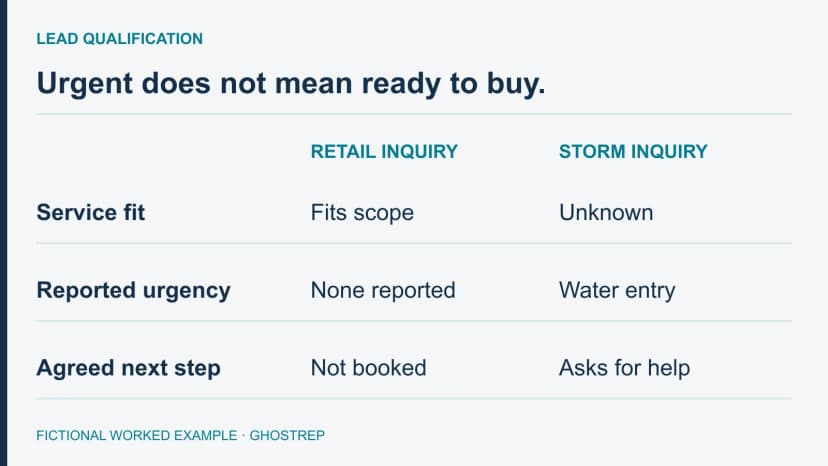
Fit, Urgency, and Readiness Answer Different Questions
The three states may influence the same conversation, but they should remain independently visible. That lets an intake employee describe what is known without turning a source label, an incomplete record, or one urgent detail into a conclusion about the whole lead.
| State | Definition and observable evidence | Unknown state and non-example |
|---|---|---|
| Company-defined fit | The requested work appears consistent with the contractor's documented service area, work offered, supported property type, and current operating scope. | Fit is unknown when the scope or location has not been verified. A referral, expensive property, certain ZIP code, or old roof is not proof of fit. |
| Observable urgency | The record preserves a reported condition or verified event that may affect timing, such as current water intrusion or a documented project deadline, without diagnosing it. | Urgency is unknown when the timing claim has not been confirmed. A storm near the property, an emotional message, or a salesperson's desire to close quickly is not proof. |
| Appointment readiness | The person is willing and able to take the next appropriate pre-appointment step, such as clarifying missing context or considering an available appointment window. | Readiness is unknown when the person's next-step preference has not been verified. A form fill, paid lead, referral, or answered call is not automatically a ready appointment. |
This is a definition table, not a scoring model. It does not produce a numeric result, predict conversion, or decide where a record should go. The companion roofing lead qualification checklist is the utility for drafting company-specific intake fields and rules without entering real homeowner information.
Company-Defined Fit Is About the Work, Not the Person
Fit asks whether the company can appropriately serve the reported project under its documented operating rules. A residential replacement contractor may fit a single-family reroof in its service territory but not a membrane-roof repair on a commercial warehouse. A repair-focused company may fit a reported flashing issue but not a full commercial coating project. Neither request is inherently good or bad. Each is either consistent with the company's current scope, inconsistent with it, or not yet clear enough to tell.
Fit should be based on objective business facts: the geography the company serves, the work it offers, the property types and systems it supports, and constraints management has actually documented. It should not be inferred from a neighborhood, property value, language, family status, disability, demographic profile, presumed income, credit attribute, or another protected characteristic or proxy.
Authority also needs careful wording. A renter reporting water intrusion is not automatically a bad lead. The person may be the first observer, may have permission to coordinate access, or may need to involve the property owner or manager. Until the appropriate decision or access authority is understood, that part of fit or readiness is unresolved. Guessing “no” simply makes the record look complete when it is not.
Lead-source economics belong in a different analysis. Use the roofing lead cost benchmarks to compare acquisition cost and sold-job math by source. Do not use a costly source as proof of fit or a cheap source as proof of poor fit.
Urgency Is a Reported Condition, Not a Closing Tactic
Urgency answers a timing question: what reported or verified fact may require prompt human attention? An intake record can preserve that a caller reported water entering a bedroom, that a tree struck part of the structure, or that a known project milestone is approaching. The intake team should not convert those statements into a diagnosis, a safety determination, a promise of availability, or an insurance conclusion.
Urgency can exist without fit. A homeowner outside the service territory may report an active leak. A commercial facility may report a time-sensitive condition to a residential-only company. The condition still deserves accurate documentation and the company's approved human handling, but it does not change the company's service capability.
Fit can also exist without urgency. A homeowner may be planning a retail replacement later in the year and want to understand the contractor's process now. The project can match the company well even though no verified event requires immediate action. Treating that person as unqualified would confuse flexible timing with poor fit.
Storm-related urgency needs particular discipline. A reported storm, hail map, roof age, or nearby claim does not prove damage at one property. A homeowner's mention of an insurance deadline should be preserved as reported information and verified through the appropriate source; the intake employee should not announce a universal filing period or predict coverage. The FTC's guidance after weather emergencies warns consumers about pressure, unlicensed operators, and missing written terms after disasters. For a legitimate contractor, the lesson is narrow: a time-sensitive situation calls for careful human handling, not manufactured pressure.
Readiness Is About the Next Step, Not the Final Sale
Appointment readiness describes whether the person is prepared to take the next appropriate pre-appointment action. That might mean considering an inspection window, clarifying who can authorize property access, or supplying a missing project detail through the company's approved system. It does not mean the homeowner has chosen a contractor, accepted a proposal, qualified for financing, or agreed with an insurance position.
A person can be ready even while comparing contractors. Seeking another estimate is not evidence of bad intent. Readiness only asks whether a useful next step can happen. Likewise, a person may express strong interest but remain unready because the timing is undecided, the appropriate property contact is not involved, or the company still lacks enough verified context to identify the right appointment type.
Readiness cannot be inherited from a lead source. In its final order involving HomeAdvisor, the FTC addressed specific misleading claims that leads were ready to hire a service provider or had submitted requests directly to the platform. That order does not prove that every marketplace lead is poor. It supports a more limited operating rule: contractors should verify readiness instead of treating a seller's label as the homeowner's current state.
Two Completed Intake Records: Fit Is Not Readiness
Fictional company rule: This contractor offers residential asphalt-shingle replacement within its stated service territory. Intake records what is reported; a qualified human reviews urgent conditions and technical questions under company policy.
- Request / source
- Homeowner requests a replacement proposal through a website form; intake confirms an in-territory residential asphalt-shingle project.
- Fit
- Requested work fits the stated company scope. This says nothing about a purchase decision.
- Reported urgency
- No active leak or deadline reported. Absence of a report does not prove the roof has no problem.
- Readiness evidence
- “I want a proposal, but I need to check my calendar before arranging the visit.” Ready to discuss the process; appointment not agreed.
- Unknown / owner
- Available appointment window and any site-access constraints remain unknown. Intake coordinator owns the clarification.
- Next action
- Explain the company’s proposal process and ask what contact or appointment step the homeowner wants. Do not record a booking that did not happen.
- Request / source
- Caller reports water appearing after a storm and asks whether insurance will replace the roof.
- Fit
- Address and work type not yet confirmed: unknown.
- Reported urgency
- Preserve the reported water entry for human review. Intake does not diagnose the source or promise a response.
- Readiness evidence
- Caller asks for help understanding the next step. No inspection slot or purchase decision is agreed.
- Unknown / owner
- Location, roof condition, coverage and the appropriate company response remain unresolved. The designated intake supervisor owns escalation.
- Next action
- Apply the company’s urgent-condition procedure and clarify service fit without turning storm exposure into damage or coverage evidence.
An urgent out-of-territory inquiry illustrates the same separation: urgency may be reported and the caller may want help, yet company fit fails under the stated territory rule. A paid lead is another source, not another readiness state. Once the next step is agreed, the pre-appointment routing workflow handles ownership and booking mechanics.
Six Illustrative Roofing Inquiries
Retail replacement with a flexible timeline
A homeowner inside the service territory reports an aging asphalt roof and wants to understand replacement options before a planned exterior renovation. The contractor performs that work, so company-defined fit appears plausible. No leak or fixed deadline is reported, so urgency is flexible rather than negative. The homeowner is willing to discuss an inspection window after checking a work calendar, which provides some evidence of readiness without proving a purchase decision.
Active leak report with incomplete project context
A caller reports water entering near a ceiling light during heavy rain but has not yet provided enough information to confirm location or property type. The reported condition may require human escalation under company policy. Fit remains unknown, and readiness is limited to the fact that the caller wants help. Intake should preserve exactly what was reported without diagnosing the source, declaring the building safe, or promising that the company can respond.
Storm inquiry with unverified damage
A homeowner says hail crossed the neighborhood and asks whether insurance will replace the roof. The property may fit the contractor's storm-restoration model, but reported storm exposure does not establish roof damage, coverage, claim eligibility, or a filing deadline. The homeowner may be ready to learn the contractor's inspection process while urgency and the underlying condition remain unverified. Keeping those facts separate prevents a weather event from becoming an unsupported sales conclusion.
Commercial request to a residential contractor
A property manager requests help with ponding water on a low-slope warehouse roof. The request sounds time-sensitive and the manager is available to coordinate access. If the contractor only performs steep-slope residential work, urgency and readiness do not create fit. This is a service-scope mismatch, not a judgment about the person or value of the project.
Paid marketplace lead with a source label
A marketplace record arrives labeled “verified homeowner” and “ready for estimate.” The source is known, but the contractor has not independently confirmed work type, service fit, reported timing, or appointment preference. All three states may still be unknown. The guide to Angi vs. HomeAdvisor roofing leads belongs to the source-comparison decision; this article only establishes that a marketplace label is not a substitute for current intake evidence.
Referral with trust but no project detail
A past customer introduces a relative who is considering roof work. The referral explains the connection and may reduce uncertainty about who sent the inquiry, but it does not reveal the service area, requested scope, timing, or next-step preference. The new person may become an excellent fit and a ready appointment. At intake, those facts are simply not established yet.
Source Labels Describe Origin, Not Readiness
Source is still useful. It helps the company understand how the inquiry arrived, whether the record might be duplicated, and which acquisition economics apply. The mistake is letting source answer questions it cannot answer.
A website form proves that information was submitted through a form. A field-generated lead shows that a rep created the record. A referral identifies a relationship. A purchased marketplace record identifies a vendor and purchase path. None of those facts, by itself, confirms that the company offers the requested work or that the person wants an appointment now.
The same boundary applies to broad marketing strategy. The guide on how to get roofing leads helps a contractor choose and compare acquisition channels. Qualification begins after an inquiry exists and asks what the current record actually supports.
Record Unknown Without Turning It Into “No”
An unknown answer means the available evidence does not support either conclusion. It is not a softer version of “no,” and it should not quietly reduce a lead's score. If the work type is unclear, fit is unknown. If a storm date is mentioned without a verified property condition or applicable timeline, urgency may be unknown. If nobody has confirmed the person's next-step preference, readiness is unknown.
A useful record preserves the missing fact in plain language and distinguishes the person's statement from the company's verification. “Caller reports water near the upstairs vent” is clearer than “emergency roof failure.” “Marketplace record says ready for estimate; appointment preference not yet verified” is clearer than “ready now.” The first version lets another employee understand the evidence. The second imports a conclusion.
Unknown should change only when new information supports the change. An intake employee should not fill gaps from property databases, neighborhood assumptions, a home's apparent value, or the lead source. Job Intel can help approved teams carry verified customer and property context into later work, but additional data still has to be relevant, lawfully handled, and interpreted within company policy.
When a Human Should Verify the Next Step
Human review matters when the record contains a reported time-sensitive condition, conflicting facts, an uncertain service boundary, or a question outside the intake employee's authority. It also matters when a third-party label claims readiness that the person has not expressed directly.
The reviewer should preserve boundaries rather than improvise an answer. Insurance coverage and claim eligibility belong to the appropriate insurer or qualified adviser. Safety and habitability questions belong to the company's approved emergency and safety procedures. Financing eligibility belongs to the authorized provider. Calling, texting, privacy, and consent requirements belong to the company's approved compliance process. A qualification label does not decide any of them.
This article does not supply the words for that conversation. When a trained team needs company-approved qualifying language, the Sales Script Generator owns the talk-track job. The state definitions here only tell the team what the conversation is trying to clarify.
Where Qualification Stops and Operations Begin
Once fit, reported urgency, readiness, and unknowns are described, the definition job is finished. The next operating problem is ownership: who verifies missing information, who handles a reported escalation condition, and where the current record lives. The companion pre-appointment routing workflow owns that handoff without turning it into a lead score.
After an appointment is booked, stop using intake states as a substitute for deal stages. The Sales Pipeline Template owns the later progression from scheduled inspection through the company's actual sales process.
For the reusable intake structure, start with the blank roofing lead qualification checklist, adapt its company-rule fields in your approved system, and keep real homeowner data out of the public generator. For the broader product path from pre-appointment context through practice and coaching, see GhostRep for roofing sales teams.
About the Author
Tim Nussbeck
Founder & CEO of GhostRep
20+ years in roofing and home improvement sales—knocking doors, running teams, and building practical coaching systems. Built GhostRep to give every rep access to the coaching top teams get.
Lead-gen next step
Turn traffic into pipeline math before you buy more leads
Start with the ROI calculator or lead-generation tools if you are still diagnosing the economics. Book a walkthrough if you want GhostRep tied to lead handling, follow-up, and close-rate lift.
- ✓Best fit if traffic is arriving but too little of it turns into revenue.
- ✓Useful for modeling conversion lift before you increase spend.
- ✓Demo shows how field execution and coaching change lead economics after the click.
Start Here
Model your conversion lift
Estimate what more leads, better close rates, and faster rep ramp are worth in revenue.
Model your conversion liftNeed it mapped to your team?
Talk through your current workflow, traffic mix, and where GhostRep fits before you change anything.
Book a 15-minute walkthroughYou Might Also Like
A practical roofing lead handoff: capture the request, assign one owner, make a useful first response, and document the next action.
Read article →Build a roofing lead response dashboard that shows speed, missed leads, contact rate, booking rate, and completed-job gross profit.
Read article →See what published roofing lead prices include, then compare all-in cost per qualified conversation using your own spend and lead records.
Read article →