Betty Score runs 50 data points on a property before a rep ever steps onto the driveway. Roof age. Storm damage history. Credit indicators. Ownership tenure. Homeowner demographics. It scores every address in a territory and surfaces the ones most likely to convert. Reps skip the long-shot doors and focus time where the math already tilts their direction.
That's not a minor feature. Betty Score clients report spending 60% less time prospecting because they're working better doors, not just more doors. For a crew running a storm-hit neighborhood, that's a real operational gain — more time at the right properties, less time walking away from dead ends.
Every one of those 50 data points is about the homeowner. None of them are about the rep.
That's not a design flaw. It's exactly what Betty Score was built to measure. But it means the most sophisticated AI targeting system in door-to-door roofing generates zero insight about what happens once the door opens — and that's where most crews quietly lose the jobs Betty Score found for them.
Next Step
Compare D2D CRM against the broader roofing CRM decision
D2D CRM fits canvassing visibility. The broader CRM choice still has to cover jobs, estimates, production, reporting, and follow-up ownership.
What D2D CRM Is Actually Built For
D2D CRM is a purpose-built field sales platform for door-to-door teams — not a repurposed real estate tool with a mobile app bolted on. Built for the field, accessible from a phone mid-route:
- Route planning and territory assignment
- Geo-fenced zones to keep reps in their lane
- Knock tracking and contact logging
- Appointment scheduling and follow-up reminders
- Real-time performance dashboards for managers
The performance dashboards are where it gets genuinely useful for managers. Real-time visibility across every rep: knock count, contact rate, appointment rate, conversion rate. If a rep is underperforming, the data surfaces it fast. For a manager running eight reps across two territories, that kind of visibility is hard to replicate any other way.
Betty Score sits on top of that execution layer. Where D2D CRM tells reps where to be and tracks what they do, Betty Score tells them which specific doors are worth their time. Together they're the most data-dense field sales setup available in roofing — and for most operations, that's a legitimate competitive advantage.
Key insight: D2D CRM gets reps to the right door at the right time with full accountability on what happens after. That's a complete execution system. It stops generating insight at the conversation.
The Data Asymmetry That Costs You Jobs
Here's what the D2D CRM dashboard cannot show you. A crew is working a hail event. Betty Score pre-screened the territory — every rep is knocking addresses with strong probability scores. Same data. Same routing. Similar knock counts across the board. The conversion rates are not similar. One rep is setting appointments at 12%. Another is sitting at 4%.
The dashboard records both numbers exactly. It has no mechanism to explain the gap — because the gap lives in the conversation, and the conversation is invisible to the CRM.
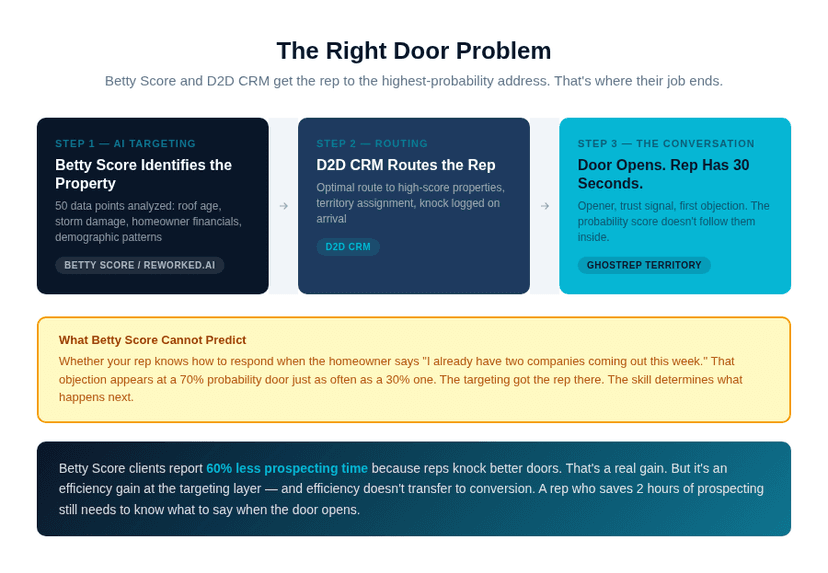
AI tools in door-to-door sales have made targeting dramatically more precise. Betty Score eliminated the wrong-door excuse — reps can no longer attribute low conversion to bad leads when AI has already pre-filtered the territory. What's left, and what's now harder to ignore, is the rep-to-rep skill gap that better targeting made impossible to explain away.
When every rep is working the same high-probability doors, the difference in outcomes is the rep.
Activity Numbers and Skill Numbers Are Different Problems
D2D CRM measures two types of data. Activity metrics — knock count, doors per hour, follow-up rate — and outcome metrics — contact rate, appointment rate, conversion rate. Both matter, but they're measuring different things and they don't fix each other. Treating them as the same problem is where most owners waste money.
A rep at 4% conversion doesn't fix that by knocking more doors. Betty Score routes them to better doors and they still convert at 4%. The routing improved. The conversion didn't.
Conversion is a function of what the rep says — the opener, the response to the first objection, whether they actually ask for the appointment — and none of that shows up in a CRM dashboard.
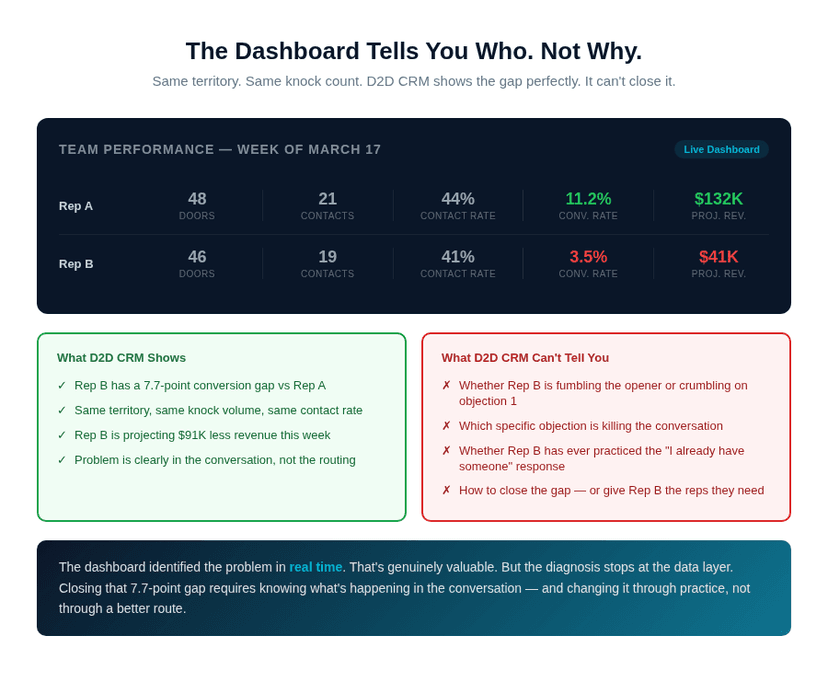
The conversion gap between your best and worst rep almost never traces back to territory or timing. It traces back to what happens in the first 45 seconds of the conversation. That's not visible in a dashboard. And it's not fixable by changing the routing.
What Actually Closes the Skill Gap
To understand why a rep is at 4%, someone has to hear them pitch. Not review their knock count — hear the actual words. What did they say after the homeowner opened the door? How did they respond when she said "I'm waiting on my insurance company"? Did they handle the brush-off or hand over a card and leave?
That diagnosis happens at the conversation level. And the fix requires practice — not a coaching session where a manager tells a rep what to do differently, but actual repetitions where the rep says the words out loud and handles the pushback in real time.
The only way to improve objection handling is to practice handling objections. Specifically. Repeatedly. With feedback fast enough to change behavior before the next door.
Consider the math. Ten-rep crew, $13,500 average ticket. Moving the 4% rep to 8% on a 40-door day means 1.6 more appointments set daily. Across a 5-day storm event, that's 8 additional appointments from one rep — from territory Betty Score already targeted. The doors were always there. The skill is what changed.
GhostRep's AI roleplay is built for that loop. A rep runs the same scenario until "I already have someone coming out" gets a practiced response, not an improvised one. The conversion number changes because the conversation changed — before it happens in the field.
Key insight: The dashboard identifies which rep needs to improve and by how much. It cannot intervene in the conversation that created those numbers. That intervention is a separate discipline entirely — and it requires practice, not reporting.
Where These Two Platforms Belong in the Same Operation
D2D CRM and GhostRep solve different layers of the same problem. D2D CRM owns execution — reps in the right territory, knocking the right doors, every lead tracked, every follow-up scheduled. The best door-to-door operations are built on exactly that kind of execution discipline. No surprises, no gaps in follow-up, full visibility for the manager.
GhostRep owns skill development — making sure what the rep says at those doors is worth the effort it took to get there.
Conversion rates at each stage of the funnel only improve through targeted skill development, not through more efficient routing. Better routing doesn't fix a broken opener. More dashboard visibility doesn't fix a rep who folds on the first objection.
The crews closing the most jobs from the fewest doors are running both.
Where owners get stuck is using the dashboard as a training plan. It isn't one. The dashboard is evidence — it shows which rep needs help and by how much.
What it cannot do is change what happens in a conversation 30 seconds after a door opens. That's the part most roofing teams leave entirely to chance, and it's exactly where the biggest conversion gains are sitting.
The Three-Layer Crew
The most complete setup runs all three layers: Betty Score identifying the highest-probability properties in a territory, D2D CRM routing reps to those properties with every knock and contact logged, and GhostRep ensuring reps have already practiced the conversation they're about to have.
A high-probability homeowner who hears a practiced opener and a confident objection response converts at a higher rate than the same homeowner hearing an improvised pitch. The targeting found the best door. The training determined what happened when it opened. The CRM tracked the result and flagged the reps who still need work.
That's a complete system. Most roofing operations run the tracking layer because dashboards are visible and easy to point to in a meeting. Training is harder to measure and easier to skip. The teams that take it seriously close more jobs from the same number of doors — and that gap compounds across a full storm season.
Key Takeaways
- Betty Score targets the right door — AI-powered lead scoring using 50 property data points predicts which homeowners are most likely to convert. It improves targeting efficiency. It doesn't prepare the rep for what to say when the door opens.
- D2D CRM is an execution and accountability tool — territory management, route optimization, real-time dashboards, knock tracking. It tells you exactly what's happening in the field with precision.
- Activity metrics and skill metrics are different — knock count measures effort. Conversion rate measures skill. Only one of those responds to better routing. Only one responds to practice.
- The dashboard identifies the gap. It doesn't close it. — knowing a rep is at 4% conversion is the beginning of the problem, not the solution. Closing that gap requires conversation-level practice, not more data.
- The complete system runs all three layers — Betty Score for targeting, D2D CRM for execution management, GhostRep for skill development. Each handles the problem it was built for.
Frequently Asked Questions
Does D2D CRM include any sales training features?
D2D CRM partners with D2D University (The D2D Experts) to offer access to external training content, but the platform itself is built for tracking and execution management, not live skill practice. The training content is supplemental and doesn't replace practiced conversation reps.
What's the Betty Score and how does it relate to D2D CRM?
Betty Score is an AI lead scoring system from Reworked.ai that integrates with D2D CRM. It analyzes up to 50 data points per property to predict conversion probability, helping reps prioritize high-value doors. It improves targeting efficiency — not rep conversation skill.
Can D2D CRM tell you why a rep has a low conversion rate?
It can show you the outcome — low appointments relative to knocks — but not the cause. It can't tell you whether the opener is failing, the first objection is going unhandled, or the rep isn't asking for the appointment. That diagnostic requires hearing the rep pitch.
Is GhostRep a CRM replacement?
No. GhostRep is a sales skill training platform, not a CRM. It doesn't track territory, manage routes, log knocks, or handle lead follow-up. It trains the conversation skills that determine conversion rates. A roofing operation needs both — one to manage execution, one to develop skill.
How much does GhostRep cost?
GhostRep publishes transparent pricing at ghostrep.ai/pricing. Prepaid hour bundles start at $200 for 25 hours — no subscription, no contracts, no demo required.
Related Articles
Free tools for door-to-door reps
Give canvassers something they can use today
Pair the strategy in this article with free tools for scripts, door hangers, homeowner texts, and field follow-up.
Field sales tools
Generate homeowner texts, canvassing assets, inspection summaries, and follow-up language.
Browse field sales tools →Training tools
Build knock tracks, objection handlers, and practice scenarios before reps burn live doors.
Browse training tools →Echo
Support reps live in the field with in-ear coaching during real conversations.
See Echo →About the Author
Tim Nussbeck
Founder & CEO of GhostRep
20+ years in roofing and home improvement sales—knocking doors, running teams, and building practical coaching systems. Built GhostRep to give every rep access to the coaching top teams get.
Field next step
Give your reps something they can use before the next knock
Start with field and training tools if you need talk tracks, follow-up language, or canvassing assets now. Book a walkthrough if you want GhostRep mapped to live field coaching.
- ✓Best fit if reps need sharper first knocks and second visits.
- ✓Useful for follow-up language, inspection texts, and canvassing flow.
- ✓Demo shows how Echo and Role Play support real field conversations.
Start Here
Browse field sales tools
Create homeowner texts, canvassing assets, inspection summaries, and follow-up copy.
Browse field sales toolsNeed it mapped to your team?
Talk through your current workflow, traffic mix, and where GhostRep fits before you change anything.
Book a 15-minute walkthroughYou Might Also Like
Compare Map My Customers and GhostRep by routing, territory execution, CRM sync, conversation practice, coaching, pricing, and roofing-team fit.
Read article →Compare RepCard's field-sales and digital-card workflows with GhostRep's AI conversation practice. See feature overlap, differences, and pilot criteria.
Read article →Compare BatchLeads property and lead-data workflows with GhostRep conversation practice. See where each product fits and what neither replaces.
Read article →