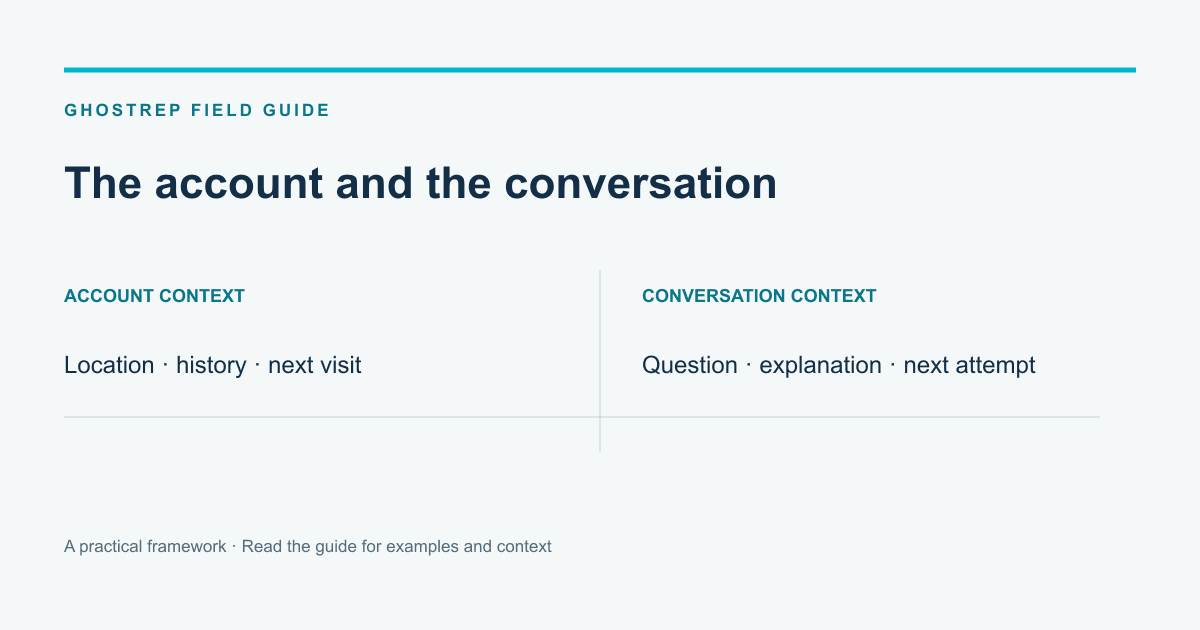
Short answer: choose Map My Customers when the main constraint is territory coverage, route planning, visit execution, activity capture, or CRM synchronization. Choose GhostRep when reps reach the right account but need stronger conversation practice, field feedback, and company-specific coaching.
The products now overlap around coaching language, but they still start from different evidence. Map My Customers starts with accounts, territories, routes, visits, and field activity. GhostRep starts with practice attempts, field conversations, company playbooks, and rep-specific coaching needs.
Map My Customers and GhostRep are not clean substitutes. They can both support a field-sales manager, but they organize the work around different systems and different failure points.
If reps miss visits, work the wrong territory, or fail to update records, evaluate field execution first. If reps complete the route but struggle to open, discover, explain value, handle objections, or earn a next step, evaluate conversation practice and coaching. A team can have both problems, but buying one category does not automatically solve the other.
Disclosure: GhostRep publishes this comparison and sells sales-training and coaching software. We reviewed Map My Customers' official pricing, platform, and route-planner pages on August 21, 2026. Those pages document vendor claims and plan coverage, not hands-on performance. Verify current features, minimums, implementation terms, and pricing directly with each vendor. Verify GhostRep on its pricing page.
GhostRep vs Map My Customers at a Glance
| Decision area | Map My Customers | GhostRep |
|---|---|---|
| Primary job | Field execution across accounts, territories, routes, visits, and activity records | Conversation practice, field-conversation evidence, and company-specific coaching |
| Starting evidence | Accounts, CRM records, routes, check-ins, notes, coverage, and field activity | Practice attempts, scenarios, call or field-conversation evidence, rubrics, and company playbooks |
| Rep workflow | Plan the day, work the route, log activity, update the account, and identify the next field action | Practice before the conversation, capture eligible field evidence, review the moment, and assign the next coaching action |
| Manager workflow | Inspect coverage, route efficiency, activity, account risk, and field execution | Inspect repeated conversation gaps, rep readiness, coaching priorities, and transfer from practice to the field |
| CRM relationship | Documents two-way sync with major CRMs at applicable tiers | Uses authorized CRM context for preparation and coaching; it is not the customer or job system of record |
| Roofing specificity | General field-sales platform; roofing-system and storm-workflow fit must be verified | Built around contractor and home-improvement sales conversations, with roofing-specific practice available |
| Best fit | The field operating rhythm is incomplete or invisible | The operating record exists, but the same conversations keep breaking down |
What Map My Customers Currently Includes
Map My Customers describes itself as a field-execution platform. Its current official material documents territory management, route optimization, activity logging, account records, check-ins, CRM synchronization, dashboards, mileage tracking, and field-performance reporting.
The current pricing page lists three annual-billing plans:
- Industry Leader at $99 per user per month: territory mapping, standard routing, activity capture, two-way CRM sync, calendar sync, and a 50,000-record limit;
- Enterprise at $139 per user per month: unlimited records, smart routing and territory tools, open API access, advanced reporting, AI Field Agent, Field View, goals, contests, and additional field-performance features; and
- Exec HQ at $199 per user per month: Enterprise features plus rep coaching pages, AI executive summaries, revenue intelligence, task and performance management, and a dedicated Field Strategy Engineer.
That scope is broader than simple route planning. Map My Customers now publishes coaching and AI-assistance features alongside field execution. Buyers should still ask what each feature evaluates. Route coverage, drive time, visit cadence, activity completion, and account follow-through are different evidence from a rep's wording, objection handling, discovery quality, or close attempt.
What GhostRep Includes
GhostRep focuses on the conversation and coaching layer around contractor sales work:
- Role Play gives reps controlled practice before a live homeowner or customer conversation;
- Echo supports authorized field-conversation capture and coaching workflows;
- AI Sales Coach connects company guidance, approved customer context, and rep performance into specific preparation and coaching; and
- Training Studio helps managers turn repeated gaps into drills, scenarios, huddles, and onboarding material.
GhostRep should not own territory assignment, route optimization, customer records, production stages, estimates, or job documentation. Those responsibilities belong in the field platform and CRM selected by the company.
Where the Products Overlap—and Where They Do Not
The overlap is manager visibility and coaching support. Both vendors describe ways to help managers identify performance gaps and guide reps. The difference is the source evidence and the next action.
Map My Customers can show that one rep covered fewer accounts, spent more time driving, skipped check-ins, or failed to maintain account cadence. Those are field-execution signals. GhostRep can help examine whether a rep practiced the right scenario, handled a recurring objection, followed the company playbook, or needs another controlled attempt before the next live conversation.
Neither signal is automatically more valuable. The right system is the one attached to the current constraint.
Use Map My Customers first when:
- managers cannot see territory coverage or visit cadence;
- reps plan routes manually or lose time between appointments;
- field activity does not reliably return to the CRM;
- account ownership and next actions are unclear; or
- the company needs a mobile field workflow around an existing CRM.
Use GhostRep first when:
- the route and customer record are correct but conversations remain inconsistent;
- new reps need controlled repetitions before expensive live opportunities;
- managers cannot observe enough conversations to coach each rep specifically;
- the same objections or follow-up failures repeat across the team; or
- company-approved language and playbooks are not reaching daily practice.
Roofing and Home-Improvement Fit
Map My Customers is designed for general field-sales organizations. A roofing company should verify whether its account model fits high-volume residential canvassing, storm deployment, setter-to-closer handoffs, property-level history, and the exact roofing CRM in use. The broader roofing canvassing software comparison explains how to test those field requirements against direct canvassing platforms.
GhostRep is built for contractor and home-improvement conversation workflows, but it still does not replace a roofing CRM or canvassing database. If the buying decision is about the source of record, use the best roofing CRM comparison. If the decision is whether CRM visibility is enough, use the roofing CRM vs AI training guide.
Can You Use Both?
Yes, if each system has a written owner and the integration preserves the source of truth.
- The field platform owns routes, territories, visits, check-ins, and field activity.
- The CRM owns the agreed customer, opportunity, estimate, job, and next-action record.
- GhostRep owns eligible practice attempts, conversation evidence, and coaching activity.
- The manager owns judgment, assignments, follow-through, and verification in the field.
Do not copy sensitive customer data into a training scenario when a fictionalized case will do. Define notice, access, retention, recording eligibility, off-hours behavior, and escalation boundaries before connecting live field data.
A 14-Day Comparison Pilot
Do not compare dashboards in separate demos. Run the products against the same operating problem.
| Test | Evidence to collect |
|---|---|
| Route and territory setup | Time to configure, ownership clarity, reassignment behavior, and duplicate handling |
| Offline field work | What can be viewed or captured without service and how conflicts resolve after reconnecting |
| CRM handoff | Objects, fields, direction, trigger, latency, errors, and the person who owns failed syncs |
| Rep adoption | Required taps, incomplete records, workarounds, and manager cleanup time |
| Conversation practice | Scenario relevance, repeat attempts, rubric consistency, and time to a successful retry |
| Manager coaching | Whether the system produces a specific next action rather than another generic score |
| Data exit | Contacts, activities, notes, recordings, coaching records, ownership, format, timing, and cost |
Set thresholds before the pilot. A polished map or a convincing AI response is not a pass condition by itself.
Frequently Asked Questions
Is Map My Customers a CRM?
Map My Customers describes its product as a field-execution platform and publishes account-management and CRM-sync capabilities. Decide whether it will be the field layer beside an existing CRM or the primary account system for the team. For roofing operations, verify where estimates, production, photos, supplements, invoices, and job documents will live.
Does Map My Customers include AI coaching?
Its current Enterprise and Exec HQ material lists AI Field Agent, coaching workflows, rep coaching pages, and executive summaries. Verify what evidence those features use, which plan includes each capability, and whether the coaching evaluates field execution, conversation quality, or both.
Does GhostRep replace route planning or territory software?
No. GhostRep is not the route, territory, canvassing-record, or CRM system. It supports conversation practice, eligible field evidence, and coaching around the work those systems make visible.
Which product is better for roofing canvassing?
Use Map My Customers when account-based field execution and enterprise CRM sync are the main requirements. Compare direct roofing canvassing platforms when door-level dispositions, storm deployment, setter-to-closer workflow, and roofing-system integrations are central. Use GhostRep when the field system is working but reps need better practice and coaching for the homeowner conversation.
Bottom Line
Choose Map My Customers when the team needs a stronger operating system for routes, territories, visits, activities, and field-to-CRM execution. Choose GhostRep when those records exist but managers still need a repeatable way to improve what reps say and do in the conversation.
If both constraints are real, use both with nonoverlapping ownership and a controlled handoff. The field platform should make the work visible. The coaching platform should make the next conversation better.
Free tools for door-to-door reps
Give canvassers something they can use today
Pair the strategy in this article with free tools for scripts, door hangers, homeowner texts, and field follow-up.
Field sales tools
Generate homeowner texts, canvassing assets, inspection summaries, and follow-up language.
Browse field sales tools →Training tools
Build knock tracks, objection handlers, and practice scenarios before reps burn live doors.
Browse training tools →Echo
Support reps live in the field with in-ear coaching during real conversations.
See Echo →About the Author
Tim Nussbeck
Founder & CEO of GhostRep
20+ years in roofing and home improvement sales—knocking doors, running teams, and building practical coaching systems. Built GhostRep to give every rep access to the coaching top teams get.
Field next step
Fix the second-visit conversation, not just the route
Start with training tools if reps need better return-visit talk tracks and objection drills. Book a walkthrough if you want GhostRep mapped to follow-up coaching and second-knock practice.
- ✓Best fit if reps are going back out but the follow-up close rate is still soft.
- ✓Useful for second-knock openers, objection reps, and return-visit practice.
- ✓Demo shows how GhostRep sharpens the conversation side of field follow-up.
Start Here
Build second-knock drills
Use the free training tools to turn return-visit objections into repeatable practice reps.
Build second-knock drillsNeed it mapped to your team?
Talk through your current workflow, traffic mix, and where GhostRep fits before you change anything.
Book a 15-minute walkthroughYou Might Also Like
Compare D2D CRM and GhostRep using a two-rep funnel, published pricing and the difference between territory operations and conversation coaching.
Read article →Compare RepCard's field-sales and digital-card workflows with GhostRep's AI conversation practice. See feature overlap, differences, and pilot criteria.
Read article →Compare BatchLeads property and lead-data workflows with GhostRep conversation practice. See where each product fits and what neither replaces.
Read article →