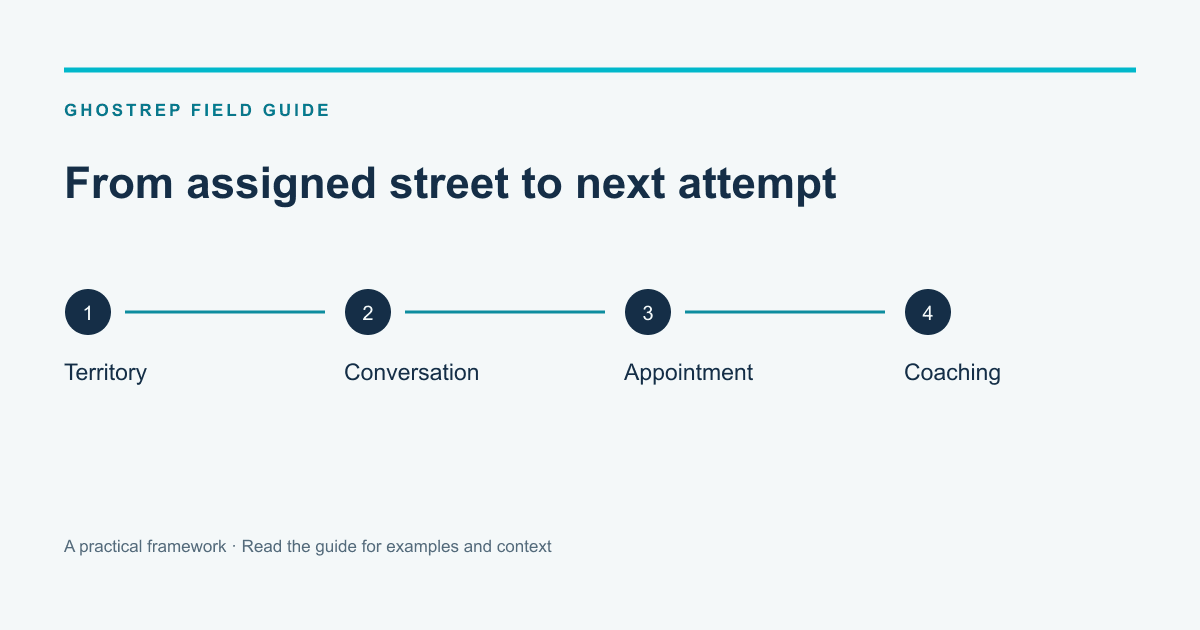
A canvassing team needs to know where to work and how to handle the conversation when someone answers. Those tasks are connected, but a route report alone does not explain why a homeowner asked for more information or declined an appointment.
Compare Knockbase and GhostRep against the part of the day your team needs to improve. Knockbase’s public site describes routing, mobile lead capture, appointment booking, rep tracking and performance tools. GhostRep connects field-conversation capture, live coaching, manager review and practice. This comparison uses published scope, not a completed head-to-head field trial.
Start with the operational question
If reps duplicate coverage, miss follow-ups or cannot find assigned work, inspect the territory and lead process. Ask how assignments are created, what a rep sees in the field and how the next person receives a requested appointment.
Knockbase’s stated canvassing capabilities make it relevant to that evaluation. Confirm the specific configuration and current offer with the provider. A feature list should lead to a demonstration of your workflow, not an assumption that the setup is complete.
Then inspect the conversation
If the team reaches customers but appointments remain unclear, review what was said. A customer may be asking about the company, the proposed service or a previous conversation with another contractor. The rep needs to establish that context before choosing a response.
Echo supports recording and reviewing field conversations and live AI coaching in the supported workflow. A manager can use the exchange to choose a coaching point rather than infer the cause from the logged outcome alone.
A useful doorstep example
Imagine a homeowner says, “We already spoke to someone.” The rep does not yet know whether that means the customer selected a contractor, requested an estimate or simply had a brief conversation. A useful response asks whether there is anything the homeowner still wants help understanding and respects their answer.
The manager can review whether the rep clarified the situation without treating a refusal as an obstacle to defeat. AI Role Play gives the rep another attempt with a different customer response. Keep the practice tied to the behavior you want to hear.
Test the handoff between activity and coaching
| Part of the day | Evidence to inspect |
|---|---|
| Assignment | The rep receives the intended territory and boundaries. |
| Visit | The outcome and relevant customer request are recorded accurately. |
| Appointment | The receiving person has the confirmed details and context. |
| Review | The manager can identify a specific exchange to coach. |
| Practice | The rep attempts the agreed change before comparable work. |
If you use more than one product, identify which record holds the customer information and how the team avoids duplicate entry. Verify the actual handoff and permissions. Do not assume an integration is working because both products mention a CRM.
Correctly model a possible conversion change
The following is a hypothetical arithmetic example, not a customer result or promised GhostRep lift. Ten reps each have 20 conversations per day: 200 conversations across the team. An appointment rate of 9% gives 18 appointments; 14% gives 28. The difference is ten appointments per day.
Over 30 working days, that is 300 additional appointments. At an assumed 50% appointment-to-job rate, it is 150 additional jobs. At an assumed $12,000 per job, the modeled revenue difference is $1.8 million.
Those are substantial assumptions. The model also requires the capacity to hold the appointments and deliver the work. Revenue is not profit or collected cash, and the calculation does not show that coaching caused the change. Reduce the assumed lift, include costs and check the actual outcomes before using it for an investment decision.
The door-knocking ROI guide can help keep conversations, appointments and completed jobs separate.
Compare price and effort fairly
Use Knockbase’s current written offer for the configuration you need. GhostRep’s published prepaid bundles are 25 hours for $200, 100 hours for $600 and 250 hours for $1,000. Include setup, training and manager review time in the comparison.
Avoid treating a lower software cost as a reason to add a tool the team will not use. Define who owns each workflow and how often it will be reviewed. The manager’s capacity is part of the rollout.
Run one controlled evaluation
Choose a team, territory and conversation skill. Record the baseline and note changes in staffing, service mix and demand. Review both activity outcomes and a sample of actual conversations during the evaluation.
At the end, identify what changed and what remains uncertain. A better route may increase opportunities without changing the rep’s explanation. A better explanation may help appointments without fixing duplicate territory coverage. Each result suggests a different next step.
Do we need both products?
Possibly, if the team needs both a canvassing workflow and a field-coaching routine. Confirm the individual need and the handoff before adding another system.
Does better routing guarantee more jobs?
No. It can support how the team reaches opportunities, but customer fit, conversation quality, capacity and other factors still affect the result.
Where should a GhostRep evaluation begin?
Bring one recurring customer question to the roofing workflow or contact sales. Decide how the manager will review the exchange and the rep’s next attempt.
Free tools for door-to-door reps
Give canvassers something they can use today
Pair the strategy in this article with free tools for scripts, door hangers, homeowner texts, and field follow-up.
Field sales tools
Generate homeowner texts, canvassing assets, inspection summaries, and follow-up language.
Browse field sales tools →Training tools
Build knock tracks, objection handlers, and practice scenarios before reps burn live doors.
Browse training tools →Echo
Support reps live in the field with in-ear coaching during real conversations.
See Echo →About the Author
Tim Nussbeck
Founder & CEO of GhostRep
20+ years in roofing and home improvement sales—knocking doors, running teams, and building practical coaching systems. Built GhostRep to give every rep access to the coaching top teams get.
Field next step
Give your reps something they can use before the next knock
Start with field and training tools if you need talk tracks, follow-up language, or canvassing assets now. Book a walkthrough if you want GhostRep mapped to live field coaching.
- ✓Best fit if reps need sharper first knocks and second visits.
- ✓Useful for follow-up language, inspection texts, and canvassing flow.
- ✓Demo shows how Echo and Role Play support real field conversations.
Start Here
Browse field sales tools
Create homeowner texts, canvassing assets, inspection summaries, and follow-up copy.
Browse field sales toolsNeed it mapped to your team?
Talk through your current workflow, traffic mix, and where GhostRep fits before you change anything.
Book a 15-minute walkthroughYou Might Also Like
Compare Map My Customers and GhostRep by routing, territory execution, CRM sync, conversation practice, coaching, pricing, and roofing-team fit.
Read article →Compare BatchLeads property and lead-data workflows with GhostRep conversation practice. See where each product fits and what neither replaces.
Read article →D2D CRM shows you exactly which rep is failing. GhostRep gives you the tools to fix it. Measuring the gap and closing it require two different platforms.
Read article →