In this article
Before a roofing sales appointment, check the current proposal, the homeowner’s unanswered question and the next decision they can reasonably make. Verify logistics, bring the right documents and rehearse one difficult moment. The completed checklist below shows how those findings change the visit.
This guide starts after booking. Use the planning tool for the blank worksheet; keep customer confirmation in its existing workflow.
What prepared looks like before a retail proposal visit
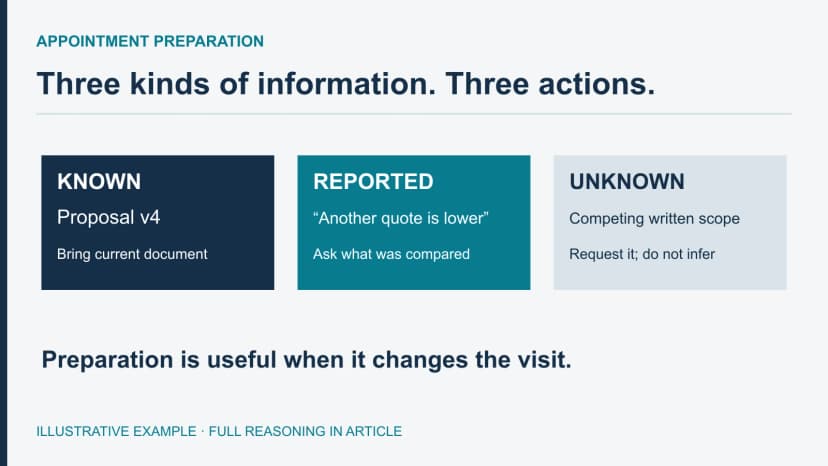
This fictional preparation record follows a booked appointment; it does not reopen lead qualification. The rep's job is to help the homeowner compare the current scope with their stated priorities, then agree on the next step. A signature is one possible outcome, not the meeting objective.
- Appointment
- Retail proposal review at the agreed address and time. Rep Jordan owns the visit. The homeowner asked to include their spouse; attendance is not yet confirmed.
- Known facts
- Inspection summary v2 and labeled photos are in the job record. The current proposal is v4. The homeowner previously asked about workmanship coverage and cleanup.
- Reported statement
- The homeowner said another contractor offered a lower price. The competing written scope has not been provided.
- Unknowns
- Whether the spouse can attend, what the competing scope includes and which warranty cost concerns the homeowner. None becomes a fact because the rep expects an answer.
- Materials
- Proposal v4, the current workmanship document and the approved cleanup explanation. Remove an outdated product sheet from the folder before leaving.
- Opening question
- “You mentioned coverage and cleanup. Which would you like to clarify first?”
- Difficult moment to rehearse
- “Their price is lower.” Practice asking what was compared without inventing omitted work or offering an unauthorized discount.
- Possible next action
- A written scope clarification for both decision-makers. Confirm what the homeowner wants after the discussion; do not prefill “ready to sign.”
The preparation changed the visit: The missing competing scope rules out a line-by-line comparison for now. The current warranty document makes the coverage question answerable within its actual language. The unconfirmed participant becomes a logistics task, handled through the separate confirmation workflow. Each finding changes an action; reading a long file without doing that is preparation theater.
When a needed fact is missing, ask its owner or narrow the appointment objective. Do not fill the worksheet with an answer the rep merely expects.
Related guidance: Roofing Sales Pre-Call Planning Checklist Generator, roofing sales call objectives by stage.
Roofing Sales Appointment Preparation at a Glance
Use the same preparation steps for retail, storm and commercial appointments, changing the source documents and decision for each.
| Preparation stage | Ready behavior | Unprepared drift | Boundary to preserve |
|---|---|---|---|
| Verify logistics | The rep confirms the booked time, format, assigned owner, appointment type, and company-approved access or attendance notes. | The rep discovers a scheduling conflict, wrong format, or missing participant at the start. | Do not reopen lead qualification or invent missing facts. |
| Review context | The rep reads the approved record and distinguishes documented facts, reported statements, and unknowns. | The rep relies on memory, a private text thread, or assumptions about the customer or property. | Keep live customer and job details in approved systems. |
| Set the objective | The rep can state what this conversation should clarify or advance and what next step would be appropriate. | The rep treats every appointment as a demand for a signature. | The objective must match the current stage and the rep's authority. |
| Gather materials | The rep brings only current, approved references relevant to this appointment. | The rep searches for documents in front of the homeowner or presents outdated material. | Materials do not replace specialist review or company approval. |
| Choose discovery areas | The rep knows which topics need clarification and listens for the homeowner's actual priorities. | The rep reads a generic question list without responding to the conversation. | Preparation sets areas to explore, not a verbatim interrogation. |
| Rehearse one difficult moment | The rep practices a realistic transition, explanation, or concern likely at this stage. | The rep memorizes a full performance and loses flexibility when the conversation changes. | Practice does not predict what a specific customer will say. |
| Arrive ready | The rep has a clear purpose, usable materials, and enough attention to listen. | The rep reviews notes while walking to the door and begins the appointment distracted. | The live conversation still determines what happens next. |
Verify the Booked Appointment and Logistics
Check the assigned rep, time, location, format, appointment type and access notes against the job record. A site inspection and a proposal review need different materials.
Use the transferred booking context rather than making the homeowner repeat intake. The lead routing workflow and qualification checklist cover pre-booking work.
For remote visits, use the virtual appointment guide for live-call setup.
Verify the company’s access and safety approvals; preparation does not certify the property as safe.
JobNimbus’s Leap integration documentation shows assigned records, tasks and upcoming appointments. In any stack, check that those items agree on the owner.
Review Only Approved Context
Read the reason for the visit, prior messages, materials sent and open questions. Keep documented facts, customer reports and unknowns distinct.
“Leak near the rear room” is a customer report, not a diagnosis. “Storm inquiry” does not establish damage or coverage. A commercial contact requesting a proposal may still need someone else’s approval.
Keep customer details in approved systems. Job Intel can support follow-up from authorized history; the public planning generator supplies a blank structure and should not receive live customer records.
Define One Objective and One Appropriate Next Step
State: “Today we need to clarify ___; a useful next step would be ___.” Define the conversation’s work, rather than the signature you hope to obtain.
For a first visit, clarify the concern. For proposal review, resolve scope or options. For commercial follow-up, confirm the review process and next information exchange.
A next step could be an inspection, revised proposal or meeting with another participant. Match it to the pipeline’s stage and exit criteria. A request for a new price does not authorize the rep to change one.
Gather the Materials Authorized for This Appointment
Bring only current documents needed for that decision: proposal and warranty for retail review, approved inspection records for storm work, site and scope references for commercial review.
Roofr’s sales-process guide separates qualification, proposals, objections and follow-up. Prepare for the scheduled stage rather than packing the entire process into one visit.
Do not invent technical, contractual, insurance, legal, manufacturer, code, or safety claims. Use the company's review path when an approved document is unclear or conflicts with the record.
Choose Discovery Areas Without Writing an Interrogation
Choose two or three topics to clarify. Leave room to hear the answer before deciding which question follows.
Use the Sales Script Generator when the team needs a talk track. Keep appointment preparation shorter: the rep should know the questions that matter without reading an interrogation.
Rehearse One Difficult Moment
My founder account explains why I put communication under pressure at the center of GhostRep. Bring the document that answers the homeowner’s question and know who can resolve what remains. A longer memorized pitch does not fill that gap.
Rehearse the likely difficult moment for this stage, using approved facts. The exercise does not predict what this homeowner will say.
For a retail proposal, the difficult moment might be explaining why two options differ without attacking a competitor or inventing product claims. For a storm-related conversation, it might be responding when the homeowner asks for an outcome the rep cannot decide. For a commercial review, it might be ending with a specific next owner when the contact cannot approve the next step alone.
GhostRep Role Play supports manager-approved scenarios and authorized follow-up context. Keep customer data in the approved workflow; the blank public tool does not transfer it into practice.
Arrive Ready to Listen and Adapt
Before walking to the door, check the objective, current documents and unanswered questions. Then stop adding material and listen.
Escalate a missing record, assignment conflict or access problem before arrival. If the homeowner’s priority changes, adapt the objective rather than forcing the planned sequence.
Afterward, use the call scorecard to review execution. Keep the actual outcome in the notes, even when it differs from the plan.
Three Roofing Preparation Examples
Retail replacement estimate visit
The rep confirms the format and participants, reviews the approved record, gathers current proposal materials, and plans to clarify the homeowner's remaining decision criteria. The rehearsal focuses on one difficult option comparison. The rep does not assume readiness to sign or invent a product, warranty, financing, or installation claim.
Storm-related inspection appointment
The rep verifies the appointment and company access process, reviews the source note without turning it into a diagnosis, and prepares to explain what the company can observe and document. The rehearsal covers redirecting coverage or claim-decision questions to the authorized source. The objective is a clear next step, not a promised outcome.
Commercial roofing review
The rep confirms the site or virtual format, expected company roles, approved project record, and relevant scope references. Discovery centers on operating priorities and the decision process, while rehearsal focuses on ending with one named next owner. The rep does not infer authority, access, technical findings, or approval from a title.
Frequently Asked Questions About Roofing Sales Appointment Preparation
What should a roofing sales rep review before an appointment?
Review the booked appointment, assigned owner, appointment type, approved company record, current sales stage, documented prior communication, materials already shared, and any visible unknowns or open items. Keep real customer and job details in approved company systems and distinguish reported information from verified company facts.
Should a rep write every question before the appointment?
No. Identify the discovery areas that matter to the appointment objective, then listen and adapt. A fixed question bank can make the conversation feel like an interrogation and can cause the rep to miss what the homeowner actually said.
How is a pre-call plan different from a sales script?
A pre-call plan organizes the appointment purpose, approved context, materials, discovery areas, likely difficult moment, and acceptable next step. A sales script provides suggested or word-for-word conversation language. Planning can identify where a script or practice scenario is useful without reproducing the script itself.
Should the plan contain customer or property data?
Live details should remain in the company's approved CRM or product workflow under its access and data-handling rules. A public generator should create a blank company template, not receive homeowner names, contact information, property addresses, claim details, recordings, transcripts, or job records.
Good appointment preparation is narrow: verify the meeting, review approved context, choose one stage-appropriate objective, gather the right materials, identify discovery areas, rehearse one difficult moment, and arrive ready to listen. That gives the rep direction without turning the appointment into a script or the plan into a decision-maker.
About the Author
Tim Nussbeck
Founder & CEO of GhostRep
20+ years in roofing and home improvement sales—knocking doors, running teams, and building practical coaching systems. Built GhostRep to give every rep access to the coaching top teams get.
Training next step
Turn training ideas into drills your reps will actually run
Start with the free training tools if you need scripts, practice reps, or coaching prompts today. Book a walkthrough if you want GhostRep mapped to your onboarding process.
- ✓Best fit if reps need more repetition, not more theory.
- ✓Useful for onboarding, objection practice, and weekly coaching.
- ✓Demo shows how Role Play plugs into your current training process.
Start Here
Browse training tools
Free objection builders, role-play prompts, scripts, and rep-practice templates.
Browse training toolsNeed it mapped to your team?
Talk through your current workflow, traffic mix, and where GhostRep fits before you change anything.
Book a 15-minute walkthroughYou Might Also Like
Build a permission-based roofing referral program with clear eligibility, compliant incentive disclosures, CRM tracking, and practical ask scripts.
Read article →Test a roofing sales script with verified claims, exact before-and-after wording, varied role play and a versioned approval record before release.
Read article →Set one roofing sales conversation objective for each appointment stage. Compare inspection and proposal-review examples with complete exchanges and notes.
Read article →