In this article
Test a roofing sales script by checking its claims, observing an internal attempt and changing one specific behavior. A polished line can still promise something your company cannot support. The example below removes an insurance promise and tests whether the correction survives a harder homeowner question.
Use the sales script generator for a draft and the script-type comparison to select its job. This seven-step review begins with the wording and sources already in hand.
The Seven-Step Roofing Sales Script Review Loop
1. Freeze the version and define its job
Give the draft a version identifier before anybody tests it. Record its owner, intended roofing sales model, conversation context, approved next step, and specialist exclusions. A broad residential appointment script may cover an opening, agenda, discovery, recap, verified value transition, concern bridge, and next-step ask. It should not quietly absorb the full door opener, financing presentation, inspection narration, or contract close.
Also record what the version is not. A blank roofing pre-call plan organizes preparation for an upcoming appointment; it is not script copy. A roofing sales call-notes template preserves the factual record after a conversation; it is not a testing score sheet. Clear boundaries prevent the review process from expanding into customer evaluation, technical inspection, or rep performance management.
2. Verify every claim and placeholder
List every statement that depends on a company fact. That includes identity, local presence, licensing, credentials, products, workmanship process, warranty, financing, availability, prior work, reviews, and any statement about what the company will do next. Trace each statement to a current approved source.
The Federal Trade Commission's advertising guide for small businesses states that advertising must be truthful and non-deceptive and that advertisers need evidence for their claims. Use that as a minimum verification standard for company claims in the script as well. If a statement cannot be verified, replace it with [Company must define and verify] or remove it. Do not downgrade an unsupported claim into vague language and call it safe.
| Script element | Approved source needed | Human review | Release condition | If verification is missing |
|---|---|---|---|---|
| Company identity, location, license, or credential | Current company record and the authoritative issuer record where applicable | Company-designated operations or compliance owner | The wording matches the approved name, scope, territory, and current status | Use a verification placeholder; never imply approval, local presence, or credential status |
| Product, service scope, or warranty | Current approved product, scope, and warranty documents | Qualified product or operations owner | The script distinguishes what is offered from what depends on a project review | Remove the detail or route the question to a qualified specialist |
| Price, payment, or financing | Current company-approved pricing or financing material for the applicable offering | Authorized finance or sales-operations owner | No term, approval, savings, or eligibility is presented as universal | Keep a neutral specialist handoff and do not quote a number or term |
| Timing, availability, or deadline | Current scheduling record or authoritative policy | Operations owner with access to the live source | The statement can be checked at the time it is used and contains no invented scarcity | Do not use urgency language; offer a company-approved next step instead |
| Technical, roof-condition, or insurance statement | Qualified assessment or approved process material appropriate to the role | Qualified technical, insurance-process, or legal reviewer as the company requires | The script explains process boundaries without diagnosing, promising coverage, or directing a claim | State that the matter requires qualified review; leave the conclusion unknown |
| Reviews, case examples, or prior work | Approved, current, attributable proof with permission for the proposed use | Marketing or compliance owner | The example is represented accurately and does not imply a guaranteed result | Use a proof-category placeholder, not a fabricated customer story |
| Permission and next-step language | Current company workflow and applicable contact or access rules | Workflow owner and any required compliance reviewer | The ask is permission-based, respects refusal, and names only an approved next step | Stop the interaction or route the question for human review |
3. Assign approval by subject
“The sales manager approved it” is not enough when the asset includes claims owned by other functions. Assign each claim category to the person qualified and authorized to approve it. Sales operations may own the conversation structure. Marketing may own approved proof. Operations may own scheduling language. A qualified reviewer may own technical or insurance-process boundaries.
Record approval of the asset version, not a general thumbs-up in a meeting. The approval record should identify what was reviewed, which source was used, and which sections remain placeholders. It should never be treated as a blanket legal opinion or permanent permission to repeat a claim after its source changes.
4. Test internal clarity through role play
Internal practice is the first place to test wording, sequence, and branching. Use Role Play or a manager-led simulation to check whether the asset is understandable without exposing a homeowner to an unfinished version. An evidence-based staff-training guide distinguishes simulated role-play practice and feedback from later on-the-job observation. That same boundary is useful here: practice can test the asset before an approved field-review process asks a different question.
Test the asset, not the rep. Ask whether two people interpret the same section consistently, whether the transition points are clear, whether the approved proof placeholder is obvious, whether a refusal ends the path, and whether an out-of-scope concern routes to the correct specialist. Do not turn this QA session into an employee score, personality judgment, or prediction of field results.
5. Use authorized field review for different questions
Role play and field review answer different questions. Practice can expose confusing instructions and missing branches. Authorized field evidence can show whether the released asset fits the real company workflow and whether a section repeatedly requires clarification. It cannot make an unsupported claim true.
If the company uses Echo or manager observation, it must first establish a lawful, company-approved basis for collecting and reviewing the evidence. Follow applicable recording, privacy, access, retention, and employment rules. Minimize customer details in the change log. A transcript or recording should not be pasted into a public generator, and the review should not infer homeowner sentiment, buying authority, property condition, claim status, or close probability.
| Review environment | Appropriate questions | Not appropriate |
|---|---|---|
| Internal role play | Is the asset readable? Are branches and handoffs clear? Does the refusal path stop? Can the user distinguish a verified statement from a placeholder? | Claiming the wording will produce a sale, grading the employee, or treating a simulated response as customer evidence |
| Authorized field review | Was the released version used? Did the wording match the approved workflow? Did the same section repeatedly require clarification? Was the specialist handoff used as designed? | Testing deception, pressure, false scarcity, unverified facts, contact permission, technical conclusions, or insurance outcomes on a homeowner |
6. Change one variable
When a problem is supported, change one defined asset variable: a section label, the order of two approved prompts, one transition, one placeholder instruction, or one routing rule. Keep the other sections stable. If the team changes the opening, agenda, discovery prompts, proof block, and next-step ask at once, it cannot tell which change resolved the original problem or introduced a new one.
One-variable discipline does not mean pretending a safety or accuracy problem can wait. Remove or quarantine any unsupported claim immediately. The discipline applies to ordinary usability revisions after unsafe language has been stopped.
7. Release a versioned asset and preserve the change record
Publish the approved version to one source of truth. Archive the replaced version, identify the effective release state, notify the roles that use it, and make the current identifier visible in the asset. Version control exists so a team can record changes and recover prior states; the official Git documentation's overview of version control describes that same basic discipline.
Do not leave old copies in private documents, onboarding folders, and message threads without a retired label. A script is not controlled if the company cannot tell which version a rep opened.
Fictional Roofing Script Change Log: One Line, Two Attempts
Fictional training excerpt: Source POL-7 revision 3 permits a rep to offer an inspection and explain the documented company proposal. It prohibits promises about insurer approval or the homeowner’s out-of-pocket cost. This invented policy is an example, not a statement of every contractor’s obligations.
Homeowner: “If I let you inspect it, will insurance pay for a new roof?”
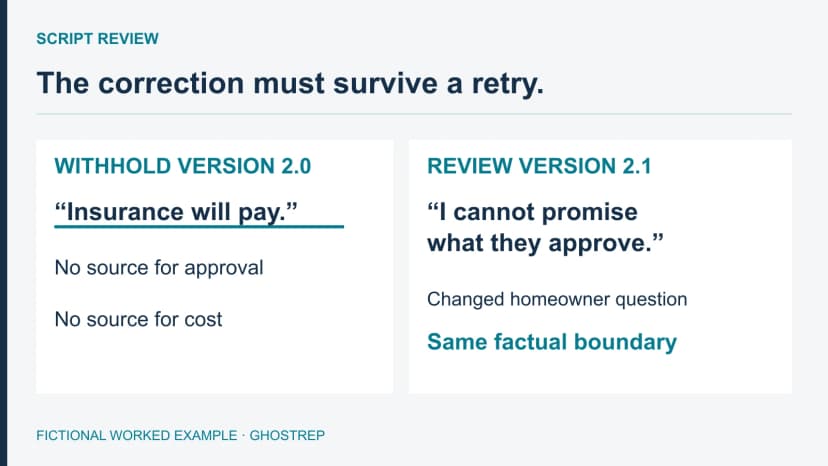
Rep, version 2.0: “Your insurer will cover the roof, so you will not pay anything.”
Review: The rep predicts both approval and cost without a supporting source. Tone and confidence cannot repair that factual failure. Version 2.0 remains withheld.
One revised line, version 2.1
We can offer an inspection and explain our documented proposal. I cannot promise what your insurer will approve or what you will owe.
Homeowner, changed retry: “My neighbor got a roof paid for. Will mine definitely be covered too?”
Rep, version 2.1: “I cannot determine your coverage from your neighbor’s outcome. Would you like me to explain our inspection process?”
The retry tests the same boundary with different pressure. It does not repeat the first question verbatim or award a pass because the homeowner sounds satisfied.
| Control | Recorded decision |
|---|---|
| Asset / change | Inspection-offer excerpt 2.0 → 2.1; change only the unsupported approval-and-cost promise. |
| Held constant | Appointment purpose, inspection offer, refusal path and next-step choice. |
| Source / review | POL-7 revision 3; sales operations reviews wording, policy owner verifies the source boundary. |
| Attempt evidence | Original exchange fails; varied retry avoids both promises and offers the permitted next step. |
| Release | Reviewer approves excerpt 2.1 for the stated use; retire 2.0 in the library and brief the people using it. |
| Next review trigger | Source revision, repeated ambiguity or authorized field evidence contradicting the intended use. |
This is approval of one training asset, not evidence of increased conversions. For source-bound draft assistance, see the reviewed ChatGPT practice example. Use authorized field review to examine a different question: whether the released wording is used correctly in real work.
When a Roofing Sales Script Should Change
A calendar reminder can prompt someone to verify that the asset still has an owner. It should not force unnecessary rewriting. Revise when there is a real trigger:
- A source changes: a product, warranty, credential, service area, approved proof item, financing offer, or company process is updated or withdrawn.
- A rule or policy changes: the company's approved contact, privacy, recording, access, safety, legal, or escalation process changes.
- The asset's job changes: the company moves from one conversation context or sales model to another.
- Repeated internal practice reveals ambiguity: multiple users interpret the same instruction differently or miss the same specialist handoff.
- Authorized field evidence reveals repeated friction: the same released section repeatedly requires clarification, while the review remains within its approved purpose.
- A new concern category appears: the team can document the category without turning one homeowner statement into a universal trend.
- A specialist asset changes: the broad framework's route to the canvassing script, cold-call script, in-home presentation, closing script, or objection handler no longer matches the current owner.
Do not trigger a rewrite because one appointment did not advance, one rep disliked a phrase, a manager heard a competitor use different wording, or the asset reached an arbitrary age. Those observations can become review inputs, but they are not evidence that the asset itself is wrong.
Frequently Asked Questions
How often should a roofing sales script be updated?
Update it when a verified source, company policy, workflow, audience need, or repeated evidence pattern changes. A scheduled ownership check is useful, but the calendar alone should not force a wording change. Every revision should name its trigger and source.
Should a roofing company test an unfinished script on homeowners?
No. Verify and approve claims before release, then test readability and branching internally. Field review should inspect only a released version through a lawful, company-approved process. Homeowners should never be used to test false scarcity, unverified proof, pressure tactics, technical conclusions, or insurance claims.
What counts as a new script version?
Any released change that affects wording, order, routing, placeholders, approvals, or intended use should receive a new identifier and change-log entry. Silent edits destroy traceability. Formatting corrections can use the company's minor-version convention, but they should still be recorded if users receive a changed asset.
Can one roofing sales script cover every conversation?
No. Keep one broad residential appointment framework and route narrower jobs to specialist assets. Door approaches, cold calls, in-home presentations, financing explanations, exact-objection work, and final signature asks occur at different moments and have different boundaries.
How can a manager identify a script problem without a conversion benchmark?
Inspect the asset itself and the approved evidence. Look for unsupported claims, inconsistent interpretations, missing refusal paths, unclear placeholders, repeated clarification at the same section, or a broken specialist handoff. A sale outcome alone does not prove the script was good or bad.
Who should approve a roofing sales script?
Approval should follow subject ownership. Sales operations can own structure; marketing can own approved proof; operations can own scheduling and workflow; and qualified reviewers should handle technical, insurance-process, legal, privacy, or financing boundaries as the company requires. After release, a connected AI Sales Coach may support practice and coaching, but it does not replace the human owners who verify the underlying asset.
About the Author
Tim Nussbeck
Founder & CEO of GhostRep
20+ years in roofing and home improvement sales—knocking doors, running teams, and building practical coaching systems. Built GhostRep to give every rep access to the coaching top teams get.
Training next step
Turn training ideas into drills your reps will actually run
Start with the free training tools if you need scripts, practice reps, or coaching prompts today. Book a walkthrough if you want GhostRep mapped to your onboarding process.
- ✓Best fit if reps need more repetition, not more theory.
- ✓Useful for onboarding, objection practice, and weekly coaching.
- ✓Demo shows how Role Play plugs into your current training process.
Start Here
Browse training tools
Free objection builders, role-play prompts, scripts, and rep-practice templates.
Browse training toolsNeed it mapped to your team?
Talk through your current workflow, traffic mix, and where GhostRep fits before you change anything.
Book a 15-minute walkthroughYou Might Also Like
Define observable roofing sales skills by selling stage. Compare two discovery attempts and see how managers calibrate evidence before assigning practice.
Read article →Use this 30-day roofing sales follow-up cadence with seven call, text, and email touches, adaptable templates, CRM steps, and clear stop rules.
Read article →Run a virtual roofing appointment using verified documents, a focused screen share and a clear next step. See a complete run of show and follow-up record.
Read article →