In this article
Set a roofing sales call objective around the appointment the homeowner actually booked. An inspection visit should establish a trustworthy starting record; a proposal review should clarify the documented offer and unresolved decision. “Get a signature” does not tell the rep what useful work to do.
Choose one primary observable job, prepare the sources it needs and record what remains open. The examples below show the exchange and resulting note. Use the pre-call planning tool and appointment preparation guide to assemble the supporting material.
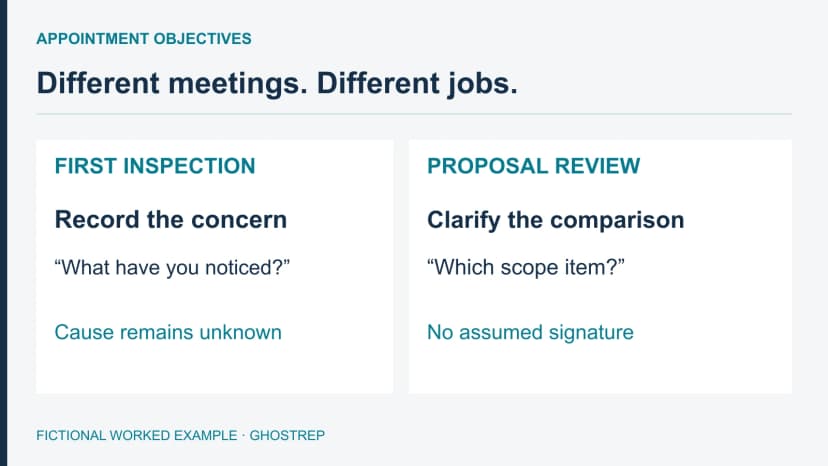
An Objective Is Not an Outcome
An objective should name work the rep can perform. The rep can review approved context, define the purpose of the meeting, listen for an unresolved concern, explain a company process accurately, separate a known fact from an unknown, and propose a specific next action. The rep cannot control whether the homeowner signs, whether an insurer approves a claim, whether financing is offered, what a qualified inspector observes, or whether a commercial committee authorizes a project.
HubSpot's pre-call planning guide recommends establishing a firm goal before the call, preparing relevant materials, and anticipating the areas the conversation may need to explore. The useful roofing translation is narrow: define one stage-appropriate job, prepare what supports it, and leave room for the customer to supply facts the rep does not yet know. Do not turn a planning hypothesis into a claim about a property or person.
Start With the Booked Appointment Stage
Objective setting begins after the appointment exists. The roofing lead routing process owns everything before that boundary: the source-of-truth record, current owner, status, next action, and transfer into a booked appointment. The objective should not requalify the lead, score the homeowner, or reopen intake decisions.
The booking record should tell the rep what kind of appointment was scheduled and who owns it. ServiceTitan's official roofing sales-visit workflow, for example, connects the customer or service location, job type, sales business unit, and available sales technician when a visit is booked. JobNimbus likewise documents that a task can be assigned to a team member, given start and due dates, and related to a contact or job in the approved CRM record through its task workflow.
Those vendor workflows are examples, not required software. The rep should begin from the company's approved record rather than a duplicate public form or assumption. If the record does not establish the stage, resolve that internal handoff gap before planning the appointment.
Roofing Sales Call Objectives at a Glance
| Appointment stage | Primary objective | Acceptable next-step examples | What belongs elsewhere |
|---|---|---|---|
| First inspection or consultation | Confirm why the visit was scheduled, explain the company-defined visit process, preserve reported concerns as reported, and establish what happens after qualified observations are documented. | A documented recap owner and a dated inspection-result, estimate, specialist-review, or information-needed step. | Diagnosing damage in advance, promising a replacement, or guaranteeing an insurance result. |
| Post-inspection findings review | Separate reported information, qualified observations, company-defined scope implications, and remaining unknowns so the customer understands what was found and what still requires review. | An estimate or proposal step, a specialist review, a documented information request, or a dated findings follow-up with one owner. | Inventing a diagnosis, interpreting insurance coverage, promising approval, or treating an observation as a final scope decision. |
| Estimate or proposal presentation | Make the company-defined scope and options understandable, clarify the customer's decision criteria, and identify the unresolved item preventing a responsible decision. | A signed agreement, a dated decision conversation, a documented revision request, or a clear no-decision state owned by the correct role. | Forcing a same-day signature, hiding scope differences, or treating price resistance as the only possible concern. |
| Follow-up or decision meeting | Reconnect the current record to the unresolved concern or agreed action and determine whether a legitimate decision or next step still exists. | A dated next conversation, requested information, approved proposal revision, company-defined nurture state, signed agreement, or documented closure of the loop. | Repeating the whole pitch, inventing urgency, or treating repeated contact as progress. |
| Commercial discovery or site meeting | Understand the stated facility concern, project context, stakeholder process, and authorized access while defining what technical follow-up is needed. | A qualified assessment, document request, stakeholder meeting, proposal-scope decision, or documented pause. | Writing a final scope on the spot, assuming buying authority, or making technical and safety conclusions outside the rep's role. |
These are stage examples, not a universal scorecard. Adapt the objective to the company's approved workflow and leave unsupported details unknown.
First Inspection or Consultation: Create a Trustworthy Starting Record
An inspection appointment normally begins with a booked visit and limited context. The objective is to connect the purpose of the visit with an accurate company process: confirm logistics, understand what the customer reported, explain the authorized inspection role, and define how verified findings will return to the customer.
Consider a retail homeowner who reported staining near an upstairs window. The rep's objective is to preserve that statement, confirm the visit scope, and ensure the qualified person documents what is actually observed. “Staining reported” should not silently become “roof leak confirmed.” The next step may be a findings recap, an estimate appointment, a repair specialist review, or a request for additional access. Each is useful because it has an owner and does not require the rep to manufacture certainty.
Appointment logistics and reminder language remain separate. If the company needs customer-facing confirmation copy, use the appointment confirmation text generator. The objective page explains the job of the conversation; it does not write or send the message.
Proposal Review: Clarify One Scope Difference
Fictional appointment: The homeowner requested a proposal comparison. Company scope P-31 revision 2 is available; the other proposal is not. The controllable objective is to identify the comparison question and document the evidence needed to answer it—not to claim your offer includes more work.
Rep: “Which part of the two proposals would you like to understand first?”
Homeowner: “The lower quote says decking is extra. Is yours all included?”
Rep: “Our current proposal does not state an allowance I can confirm. I need the estimator’s written clarification before comparing that item.”
Homeowner: “Send that answer and I will review it. I am not deciding today.”
- Objective result
- Comparison question identified; scope answer remains unresolved. The rep completed clarification, not the comparison itself.
- Source / unknown
- P-31 revision 2 reviewed. Competing scope not reviewed; company decking allowance not yet confirmed.
- Next action / owner
- Estimator supplies written clarification; rep sends the reviewed answer. No signature, installation slot or decision date agreed.
The stage matters: repeating an inspection introduction would waste this meeting; pushing for a signature would bypass the source question. The script generator supplies a broader talk track, and closing language supports an appropriate decision ask when the needed facts are clear. This exchange demonstrates objective selection.
First Inspection: Establish the Concern and Permitted Next Step
Homeowner: “There is a stain in the upstairs ceiling. I want someone to look at the roof.”
Rep: “What have you noticed, and what would you like the inspection to help clarify?”
Homeowner: “Whether the roof is involved and what happens next.”
Rep: “I will record that concern for the qualified inspector. I cannot diagnose the cause from this conversation.”
Finished note: Customer reports upstairs ceiling stain and requests inspection to clarify cause and next steps. Cause unknown; inspection findings not yet available. Rep records the concern and follows the company’s access and inspection process. No repair scope or coverage conclusion was made.
If the inquiry has not reached a booked appointment, first separate service fit from appointment readiness. After the conversation, write the note and owned next action so the objective is visible to the next person.
Post-Inspection Findings Review: Keep Facts, Reports, and Unknowns Separate
A findings review begins after an authorized role has documented observations. Its job is to explain what the approved record says, distinguish observations from conclusions, identify what remains unknown, and establish the next company-defined step. In a retail job, that may mean separating observed conditions from the proposed scope. In a storm or insurance workflow, extra parties may be involved and the customer may not know which decisions belong to the contractor, insurer, adjuster, policyholder, or another specialist. The rep's objective should still be accuracy and next-step clarity—not a coverage prediction.
Imagine that a homeowner has an insurer estimate, contractor photos, and questions about an omitted area. A useful objective is to understand which documents exist, explain the contractor's documented scope or observations, identify what needs technical or specialist review, and agree on the authorized next exchange. The rep should not announce that an item will be approved, interpret policy language, create a universal filing deadline, or turn nearby hail into proof of damage at the property.
The conversation should make the record cleaner. Customer reports, contractor observations, and insurer communications retain their source. Unknowns remain open until the appropriate party resolves them. Progress is a better-defined next action, not a more confident prediction.
Commercial Discovery or Site Meeting: Define the Decision and Technical Path
A commercial walkthrough may involve a property manager, facilities contact, owner, asset manager, consultant, or board, and the person attending may not hold every decision right. The objective is to understand the stated facility problem and buying process, establish the authorized access and documentation boundary, and determine which technical work must happen before a responsible proposal or recommendation can be prepared.
For a warehouse with recurring water intrusion, the conversation job might be to map the reported locations, learn what prior records are available, identify the operational constraints the facility contact considers important, and determine who can authorize the next assessment or document release. It is not to declare the roof system's cause of failure from a conference-room conversation or produce a final replacement scope before qualified review.
The next step should reflect the actual commercial process: a technical assessment, records request, stakeholder meeting, preliminary scope discussion, or documented pause. Sales coordination is not engineering, safety, legal, or procurement authority.
Follow-Up or Decision Meeting: Resolve One Open Loop
A follow-up objective begins with history. The rep should know what was previously discussed, what each side agreed to do, what remains open, and whether the customer still wants to continue. GhostRep Job Intel is the product path for approved customer and job context; a public planning article should never ask a rep to paste private customer history into an open generator.
Suppose a retail homeowner asked for a revised ventilation option. The objective is to reconnect to that item, confirm whether the revision was delivered, understand what remains undecided, and establish a real next step. Repeating the original presentation or inventing urgency would ignore the reason for the follow-up.
A productive result may be a dated decision conversation, a new information request, an approved proposal revision, a company-defined nurture state, or a clear decision not to continue. The rep controls whether the record and next action are accurate; the rep does not control the customer's final choice.
Turn the Objective Into Preparation and Practice
Once the stage objective is clear, preparation becomes smaller. The rep reviews relevant approved context, gathers the necessary materials, notes important unknowns, and chooses one difficult moment to rehearse. If an item does not support the conversation job, it may not belong in the plan.
Practice is a separate action. GhostRep Role Play lets reps rehearse a comparable conversation before a live appointment. The objective supplies the practice target—for example, keeping an estimate comparison focused on scope or explaining the contractor's limited role in an insurance conversation—without scripting a real customer or predicting how that person will respond.
After the customer conversation, the workflow changes again. Use the roofing sales call scorecard to review observable behavior in a completed conversation. That page owns evidence, ratings, and coaching. This article stops before the call and does not grade a rep, create post-call notes, or treat the sale outcome as the score.
Common Objective-Setting Mistakes
Using the sale as the only objective
A sale is a possible outcome. Replace it with the work the rep can control: clarify the decision, explain the approved scope, resolve one open issue, or agree on the next action.
Giving one appointment five primary jobs
A rep who must inspect, educate, present, overcome every objection, collect documents, and close in one undefined meeting has no priority. Name the primary stage and one main conversation job. Record secondary needs without pretending they all have equal importance.
Planning from assumptions instead of approved context
Roof age, storm proximity, neighborhood, property value, lead source, prior silence, or an emotional message does not prove damage, readiness, coverage, or buying intent. Use the approved record and preserve unknowns.
Turning the objective into a hidden script
An objective describes the job and next-step boundary. It should not contain a monologue, question sequence, rebuttal, or closing line. Those assets need their own review and practice workflow.
Changing the objective after learning the outcome
Lock the objective before the appointment. If the customer introduces new information, the rep can adapt responsibly, but the manager should not redefine success afterward simply because the sale closed or did not close.
Frequently Asked Questions
What is a roofing sales call objective?
It is the controllable conversation job for a specific booked appointment. It should state what the rep needs to clarify, explain, or advance and the next step that work should make possible. Technical verification remains with the authorized role.
Is closing the sale a valid call objective?
A signed agreement may be an appropriate possible outcome at a decision-stage appointment, but it is not fully controllable. The objective should describe the work leading to a responsible decision, such as clarifying the proposal, understanding the unresolved concern, and defining the next action.
Should every roofing appointment use the same objective?
No. A first inspection, post-inspection findings review, estimate or proposal presentation, follow-up or decision meeting, and commercial discovery visit begin with different records and should produce different next steps. The objective should match the actual appointment stage and company workflow.
How many primary objectives should a rep set?
Use one primary conversation job so the rep knows what matters most. The plan can preserve secondary topics and unknowns, but it should not turn them into competing definitions of success. This is an operating clarity rule, not an industry performance benchmark.
Can a rep enter customer information in a public planning tool?
No. Keep names, addresses, phone numbers, claim or policy information, financial details, recordings, transcripts, and other customer or job data in the company's approved systems. A public generator should create a blank reusable framework only.
How is a call objective different from a script or scorecard?
The objective defines the conversation's job before it begins. A script provides approved language for parts of the live conversation. A scorecard evaluates observable behavior after the conversation. Keeping those three jobs separate gives each page and each manager workflow a clear purpose.
About the Author
Tim Nussbeck
Founder & CEO of GhostRep
20+ years in roofing and home improvement sales—knocking doors, running teams, and building practical coaching systems. Built GhostRep to give every rep access to the coaching top teams get.
Training next step
Turn training ideas into drills your reps will actually run
Start with the free training tools if you need scripts, practice reps, or coaching prompts today. Book a walkthrough if you want GhostRep mapped to your onboarding process.
- ✓Best fit if reps need more repetition, not more theory.
- ✓Useful for onboarding, objection practice, and weekly coaching.
- ✓Demo shows how Role Play plugs into your current training process.
Start Here
Browse training tools
Free objection builders, role-play prompts, scripts, and rep-practice templates.
Browse training toolsNeed it mapped to your team?
Talk through your current workflow, traffic mix, and where GhostRep fits before you change anything.
Book a 15-minute walkthroughYou Might Also Like
Test a roofing sales script with verified claims, exact before-and-after wording, varied role play and a versioned approval record before release.
Read article →Define observable roofing sales skills by selling stage. Compare two discovery attempts and see how managers calibrate evidence before assigning practice.
Read article →Practice roofing objections with complete simulated conversations, observable scoring and manager feedback. Turn one missed behavior into the next drill.
Read article →